
True job security now depends on what humans do best. You must know the secret. The most durable jobs safe from AI, such as healthcare workers, AI Ethicists and specialized Skilled Tradespeople.
Yet, focus on capabilities that machines cannot replicate. These are complex judgments, true originality and deep emotional connection.
Your professional security stems from using AI to automate common or everyday tasks. This frees your time for the high-value human work that drives growth.
I’ll be honest, I once had the same fear. When AI tools first arrived, I thought they would render my work in digital marketing obsolete. Then I tried using them as helpers, not threats.
Now, I treat AI like my handy worker. It handles the repetitive stuff while I focus on strategy, ideas and human connection.
I now believe the future belongs to those who adapt their expertise to lead the technology, rather than those who avoid it.
Jobs Safe from AI – Fields That Will Grow with AI
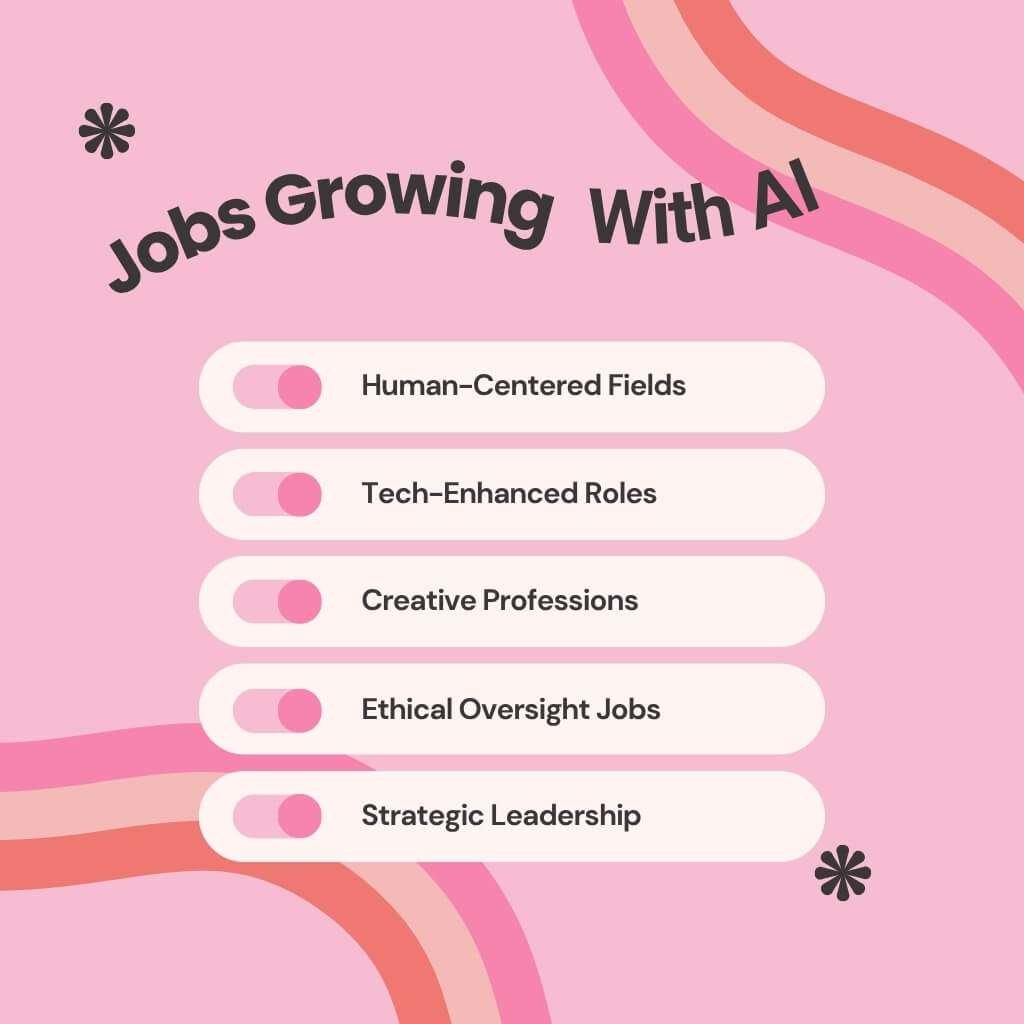
We must look past “safe” jobs. Instead, we must identify professions that will gain value due to the impact of AI.
These fields do not survive automation; instead, they excel by leveraging technology to enhance human service. They are the strongest engines of US economic growth right now.
10 AI-Proof Careers
| Job Title | Primary Anti-AI Skill | Thriving Sector |
| Nurse Practitioner | Emotional Connection & Clinical Judgment | Human Care & Wellbeing |
| AI Ethicist | Moral Accountability & Governance | AI Development & Oversight |
| Physical Therapist | Hands-On Adaptability & Custom Coaching | Human Care & Wellbeing |
| Wind Turbine Technician | Unpredictable Physical Dexterity & Safety | Skilled Trades & Physical Work |
| Mental Health Counselor | Trust-Building & Social Intuition | Human Care & Wellbeing |
| UI/UX Designer | Originality & Human Flow Design | Creative Intelligence |
| Cybersecurity Analyst | Adversarial Thinking & Intuitive Threat Detection | AI Development & Oversight |
| Electrician | Custom, Non-Routine Problem-Solving | Skilled Trades & Physical Work |
| AI Education Designer | Strategic Mentorship & Curriculum Vision | Education & Mentorship |
| Choreographer | Unbounded Artistic Originality & Movement Direction | Creative Intelligence |
1. Human Care & Wellbeing
Caring for people requires fundamental human traits: empathy, touch and building trust. AI cannot substitute these things. This sector remains the top job creator in the US.
How They Lead:
Therapists, social workers and nurses manage complex emotional situations. This work needs deep, personal human contact.
Massive Demand: The aging US population constantly drives new needs.
BLS Data: Healthcare and Social Assistance is the single fastest-growing sector in the US, projected to lead job creation through 2034.
Occupations such as Nurse Practitioner and Physical Therapist Assistant exhibit some of the highest projected growth rates in the entire US economy (Visual Capitalist).
2. Creative Intelligence
AI is a world-class imitator. It is not the original inventor. Writers, designers and artists utilize AI to expedite production. This frees up their human time for strategic vision and ethical judgment.
How They Grow:
Intent and “Taste”: Designers use AI to produce many options quickly. Their skill lies in choosing the best, most culturally relevant, or most ethical option. They provide the original intent.
Role Transformation: Traditional roles, such as Graphic Designer, may decline. But UI/UX Design (user experience design) is among the fastest-growing job roles globally (WEF Future of Jobs Report 2025). This illustrates the shift in focus to human-centric digital creation.
3. Skilled Trades & Physical Work
These hands-on roles thrive because they involve unpredictable physical spaces. Machines struggle with environments that are messy, unique and constantly changing.
How They Grow:
Adaptive Solutions: Plumbers, electricians and mechanics must solve problems that have no manual. Every burst pipe or broken engine is a unique puzzle needing on-the-spot improvisation.
Infrastructure Need: Demand is high across the US due to aging infrastructure and the development of new energy projects.
Energy Trends: Careers tied to green infrastructure are experiencing a surge in demand.
Solar Energy Technicians and Electricians are seeing very high demand and growth rates. This confirms the long-term job security in these trades (The Blue Collar Recruiter).
4. Education & Mentorship
Education is built on human inspiration, coaching and emotional guidance. This cannot be automated.
How They Improve:
Emotional Support: Teachers recognize student anxiety and foster curiosity. AI can deliver personalized lessons. But it cannot mentor character or build confidence.
Digital Leadership: The modern teacher manages AI tools to personalize student work. Their job becomes high-level facilitation and complex discussion leading, moving away from repetitive lecturing.
5. AI Development & Oversight
This field is the human center of the AI universe. The professionals who build, guide and protect AI systems are essential.
How They Win:
Ethical Safety: As AI becomes common, the need for AI Ethicists and Compliance Officers is soaring.
These roles ensure that AI systems are fair, unbiased and compliant with legal requirements. The AI governance market is projected to surpass $20 billion by 2026 (McKinsey, WEF).
New High-Value Roles: Generative AI Engineers and AI Security Experts are among the highest-paid and most in-demand technical roles. They apply human creativity and judgment to the machines themselves.
Case Study: The Amplification of Therapists at Headway
Company: Headway (Mental Healthcare Platform, New York, USA)
The Story: Headway utilizes advanced algorithms to automate the most tedious aspects of a therapist’s job. This includes insurance paperwork, billing and client acquisition. These administrative tasks often took up half of a therapist’s week.
The Pivot: By automating administration, Headway allows therapists to dedicate nearly 100% of their time to patient care. The platform essentially maximized the efficiency of the human professional.
The Outcome: The AI did not replace therapists. It multiplied their effectiveness. This growth model confirms that the human care provider remains the indispensable, high-value asset in the healthcare system.
What Makes a Job Truly Safe from AI?
Worry about AI taking jobs is old news. The current focus is on where people create unique, non-replicable value.
1. Define AI Safety – Your Professional Fortress
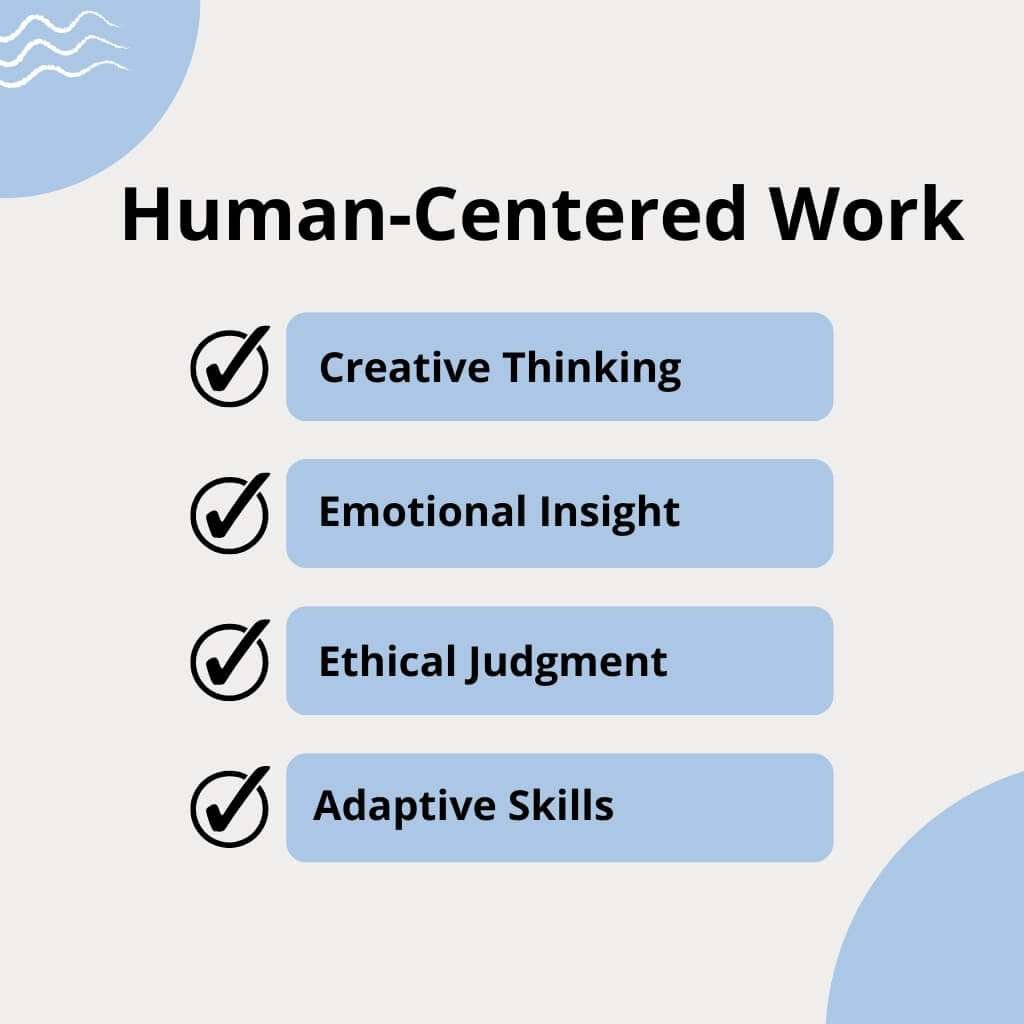
A job stands safe from full automation when its main success depends on things outside of data processing. We use three clear points to define “AI Safety.” These are:
1.1. Resistance to Automation
This means the job requires tasks that are irregular and unpredictable. AI excels at routine, repeatable tasks, such as filing or generating standard reports.
Safe jobs occur in situations where the environment changes rapidly and requires customized solutions.
Example: A roofer dealing with unexpected structural damage on an old house. Each fix needs unique judgment and physical adjustment.
Principle: Non-routine physical and contextual work resists simple coding.
1.2. The Human Edge
This factor focuses on tasks where the final result relies on a genuine personal connection and moral standing.
AI manages data. But it cannot earn trust or feel accountability. Employers highly value ethical stability and true client loyalty.
Notable Insight: As AI makes things more efficient, the market values human depth and nuance. The ability to build meaningful relationships is more highly valued.
1.3. Adaptive Skill Value
Job safety belongs to the worker who manages the AI tools. They use AI to handle routine tasks.
This gives them more time for strategic thinking and original human direction. This ongoing ability to learn and apply new systems makes a job defense lasting.
Result: The worker becomes a strategic director and decision-maker, not just a task handler.
2. The Core Difference: AI Logic vs. Human Judgment
AI and human minds solve problems differently. AI uses calculation; humans use conscience and context.
| AI’s Capabilities (Fast Calculation) | Human Traits (Context, Ethics, Purpose) |
| Pattern Recognition | Moral Judgment |
| Data Processing (Scale) | Empathy (Social Insight, Trust) |
| Optimization (Efficiency) | Accountability (Ethical Weight) |
| Content Synthesis | Originality (New, Purposeful Creation) |
AI identifies correlations in large datasets. It predicts the next word or financial risk.
Human judgment adds contextual and ethical checks to that prediction. AI excels at counting; humans excel at caring and creating.
The US Bureau of Labor Statistics (BLS) focuses on how technology changes tasks within jobs.
For example, AI assists software developers with routine coding and testing.
But the demand for developers is still projected to increase by 17.9% (2023–2033).
Why? Because humans are still needed for complex problem-solving, defining product vision and managing AI systems themselves.
3. The Real Shift: Role Change, Not Job Loss
The biggest change brought about by AI is not the loss of jobs, but rather the transformation of work.
But the transformation of roles. AI breaks jobs into tasks, then automates only the repetitive and mundane parts. This forces workers to focus on higher-value activities.
The Change in Focus
Lawyers now use AI for faster document review. The lawyer’s new value rests on courtroom persuasion, complex negotiation and client rapport—skills machines cannot mimic.
Why are some jobs still safe when AI is everywhere?
Jobs stay safe because they need unbounded human thought. AI intelligence is narrowly limited by the training data it receives.
A person can quickly switch knowledge, solve a problem never seen before, or manage a tense client conversation.
These actions need Theory of Mind (understanding others’ feelings) and subjective wisdom. AI cannot achieve these things.
Specialist Opinion
“AI will not replace humans, but people who use AI will replace those who don’t.” – Ginni Rometty, Former CEO of IBM.
Case Study: The Transformation at QuickLoan Financial
Company: QuickLoan Financial (Hypothetical name for a US-based loan approval service based on 2025 case studies)
The Story: QuickLoan Financial integrated a sophisticated AI model to handle most loan applications. The AI automatically evaluated credit history and financial risk factors.
Before AI: Loan officers spent hours manually collecting and reviewing applicant data.
After AI: The loan officers’ jobs became Financial Client Strategists. The AI performed the calculations. But the person made exceptions, negotiated terms based on human relationships and advised clients on complex financial planning.
The Outcome: The time needed to process loans dropped by 40%. More importantly, the value of human strategists rose.
Core Human Skills Machines Still Cannot Match
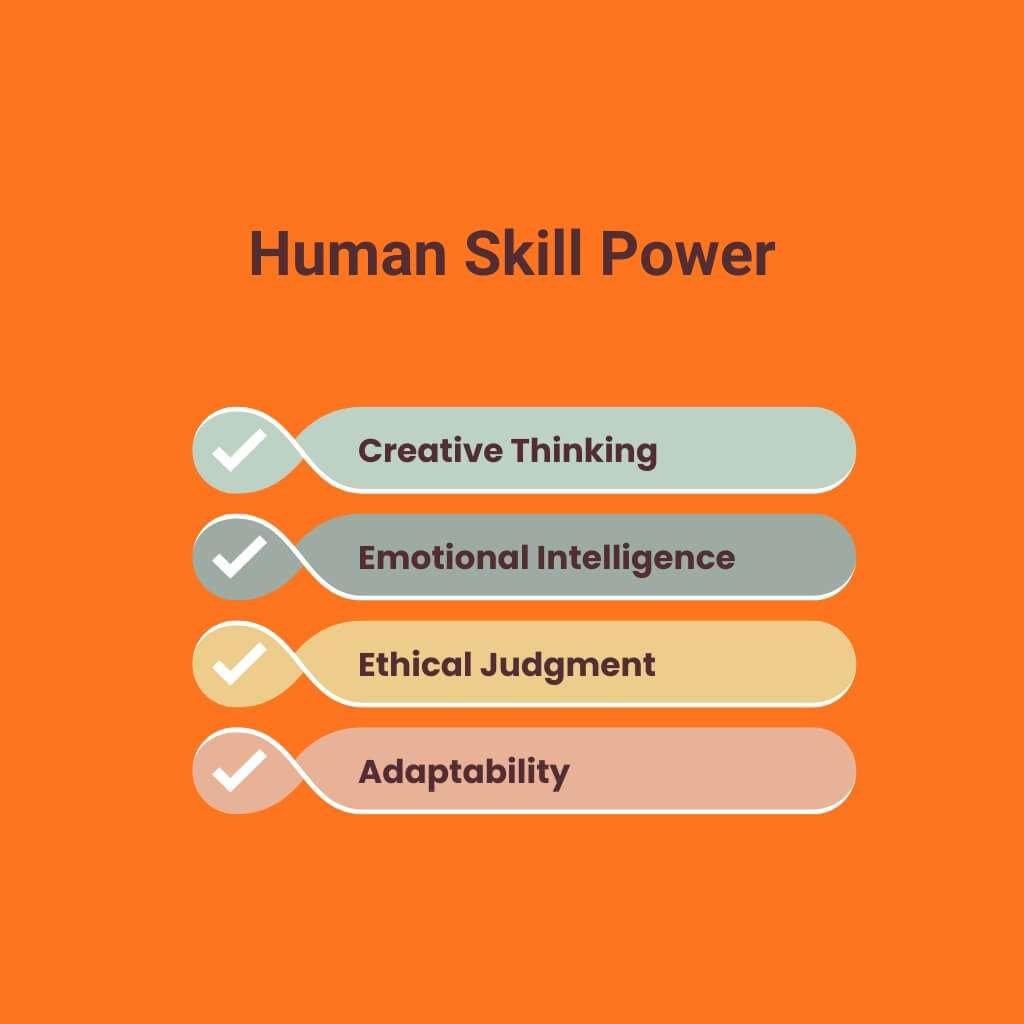
The debate about job security must move beyond lists of safe jobs. True professional strength comes from mastering the essential human capabilities.
AI cannot replicate. These traits anchor your career in psychology, social interaction and adaptability.
A . The Three Human Pillars AI Cannot Replicate
AI excels at data processing. Humans excel at context, emotion and originality. These three pillars create the ultimate defense against full automation.
Pillar 1: Emotional Intelligence and Connection
Emotional connection is the ability to feel, interpret and manage human sentiment. AI can analyze tone and recognize facial expressions, yet it fails at genuine emotional exchange.
Empathy and Social Intuition: This means understanding unspoken cues, cultural nuance and underlying motivations.
A successful manager uses this approach to resolve team conflicts before they escalate into costly disputes.
Trust-Building: Trust is the basis of consulting, therapy and leadership. This deep confidence requires a human presence.
A financial advisor, for example, secures long-term client relationships through personal reassurance, rather than just relying on algorithmic performance.
Pillar 2: Creative Reasoning and Originality
This is the ability to produce entirely new concepts outside of established patterns. AI excels at generating content based on its extensive training data. It is a powerful imitator and synthesizer. It is not a true inventor.
Unbounded Invention: Real human creativity involves combining entirely different fields of knowledge to solve novel problems.
This transformative creativity (introducing novel concepts) differs from the combinatorial creativity (mixing existing ideas), where AI shines.
Context-Based Decision-Making: Humans assess moral, cultural and situational factors before making a decision. AI provides probability; humans provide purpose and ethical judgment.
Pillar 3: Physical Dexterity and Unpredictability
Work conducted in fluid, messy and non-standardized environments remains highly dependent on humans.
Robots perform well in structured settings (factories). They perform poorly when the environment changes on a minute-by-minute basis.
Adaptive Dexterity: The ability to use complex tools while adjusting to unexpected changes. A mechanic identifying an obscure engine fault by sound and touch, or a firefighter navigating a dark, debris-filled hallway, shows this skill.
Non-Algorithmic Problem-Solving: Jobs involving unpredictable physical environments require constant on-the-spot improvisation that cannot be pre-coded.
What human skills are hardest for AI to copy?
The most challenging skills for AI to replicate are Theory of Mind and Wisdom.
Theory of Mind: The ability to understand that other people have beliefs, intentions and desires different from one’s own. This capacity is essential for negotiation, sales and complex team leadership.
Wisdom/Discernment: The skill to sense whether an action should be done, not just how to do it efficiently. This involves deep contextual, ethical and historical knowledge that AI cannot truly possess.
B . The Trend: Hybrid Roles as the Future
A secure future career is not one that avoids AI, but one that actively integrates it. This gives rise to the concept of the Hybrid Role. These professionals are fluent in both digital tools and human complexity.
Definition: Hybrid roles combine technical expertise (digital proficiency, data analysis) with high-value human skills (emotional intelligence, communication, critical thinking).
Practical Example: A Registered Nurse uses an AI diagnostic tool to prioritize patient vitals and flag potential risks.
The nurse’s job security relies on the human advantage of delivering comfort, exercising judgment on treatment exceptions and communicating complex information empathetically to patients and their families. The AI saves time; the human provides the care.
How to Secure Your Career for Tomorrow
Worries about job security lead to one clear question: How do I make my job future-proof?
The answer is simple. Stop viewing AI as a competitor. Start seeing it as a professional growth tool.
Job durability relies on adapting skills and changing your career focus. The most secure jobs are hybrid—they blend machine efficiency with human strategy.
1. Preparing for the AI-Driven Job Market
Future job security is an active choice. You must focus training on the few things AI cannot perform.
1.1. Develop Hybrid Skills
A hybrid professional speaks both the language of technology and the language of people.
Mix Empathy and Tech Fluency: Learn to Utilize AI for Routine Tasks. Spend the saved time mastering emotional intelligence (EQ), negotiation and leadership.
AI Literacy is the New Typing: You do not need to code the AI. You must know how to command it, question its results and use it ethically. This ability to audit AI output becomes a required skill.
1.2. Focus on Roles AI Supports, Not Replaces
Look for jobs where AI enhances human strategic work by making it faster and more effective.
Example: AI can draft a complex financial report. The human job is now to assess the moral risk of the advice and communicate the findings clearly to the client. This shift moves you from a data collector to a trusted consultant.
Principle: Focus on judgment-intensive roles.
1.3. Continuous Learning is Career Insurance
The pace of AI change makes lifelong education essential. Skills have a short lifespan. Learning should become an integral part of your daily work routine.
Micro-Learning: Use short online courses, webinars and certifications (e.g., in Prompt Engineering or AI Ethics).
Digital Tool Mastery: Practice using new generative AI tools monthly. Stay current with platforms like AWS, Azure, or Google Cloud, as they form the backbone of modern business.
2. Reskilling Paths: Your Career Pivot
Many professionals can leverage their current skills to transition into high-demand, AI-resistant roles. This is called reskilling.
| Old Role (High Automation Exposure) | New Reskilling Pathway (Low Automation Exposure) | New Focus |
| Healthcare Assistant | Patient Experience Manager | EQ, Conflict Resolution, Service Design |
| Teacher | AI Education Designer | Curriculum Strategy, Digital Tool Integration, Mentorship |
| Journalist/Content Creator | Content Strategist (AI-Augmented) | Brand Voice, Ethical Fact-Checking, Narrative Direction |
| Data Entry Clerk | AI Data Curator/Auditor | Data Governance, Bias Checking, Model Training |
Conclusion
Your professional future shines when you prioritize originality, moral clarity and true compassion.
These traits are permanent. Careers in client care, complex physical trades and technology governance are set for massive expansion.
Success means changing your focus. Let AI handle the basic tasks. Invest in your humanity.
FAQ
Will AI raise my non-tech salary?
Yes, often. AI handles low-value tasks like billing. This means experts (like Therapists) have more time for high-fee client work. Higher efficiency generally leads to better pay.
What non-tech certificates are best for AI security?
Focus on AI Governance and Ethics. Look for the Certified AI Governance Professional (AIGP). Additionally, Project Management Professional (PMP) certification with a tech focus helps you lead AI projects safely.
Will salary negotiation be harder with AI?
No, it becomes easier and fairer. You use AI to quickly find exact market pay data. This grounds your pay request in verified facts, rather than mere speculation.
What is the biggest hidden risk of AI for small business jobs?
The biggest risk is AI bias leading to legal trouble. If an AI hires unfairly, the company can be sued. This creates new, high-paying jobs for human auditors who verify the fairness of AI models.
What entry-level jobs are safest from robots?
Entry-level jobs that require immediate hands-on action are the safest. Think Dental Hygienists, Physical Therapist Assistants, or Wind Turbine Technicians. They all require a personal touch and unpredictable movement.
Should I master just one AI tool for safety?
No. Tools change quickly. Focus on logic and problem-solving. You must be ready to apply human judgment to any new AI tool that appears next month. That is the real skill.
How will AI change a CEO’s job?
AI handles routine reports for the CEO. The CEO’s job changes to managing the company culture and long-term vision. Their value is making tough, ethical decisions that no machine can make.
Does AI lower the need for emotional skills anywhere?
Yes, but only in simple tasks. AI takes over basic customer complaints. The human role is then focused on complex, high-stakes emotional problems. Here, genuine empathy is the only thing that can save the customer relationship.
Which market will see the highest pay increases due to AI?
Tech will see the highest percent pay growth for AI specialists. Healthcare is expected to create the largest number of new jobs overall. Both are secure, but Tech offers faster and higher-end salary spikes.
How should an older worker reskill for the AI economy?
Older workers should combine their long experience with basic AI fluency.
Their wisdom in client relations, history and leadership is a non-automatable asset. They should avoid competing on new coding speed.

Aliza Khatun is a Digital Marketing Professional and the founder of DigiGenHub. She has helped various businesses grow their online presence through real-world experience in marketing, branding, traffic growth, and business strategy.
Through DigiGenHub, she shows how to build and grow a business from the ground up using Website Setup, SEO, Branding, Paid Promotion, and smart digital tools.
She also highlights how AI can be used to its full potential to make content creation, automation, marketing, and business growth faster and smarter.
She believes that the right knowledge, modern technology, and the right tools can help any individual or business build a stronger online presence.