Online businesses rely on AI for content, ads and design. But AI can favor certain templates, messages, or visuals, unintentionally confusing users or hurting sales.
Indeed, businesses struggle when AI tools handle designs. Wrong color choices or limited templates can confuse users and reduce sales. So the company need an AI ethics specialist.
Now they guide marketing, product features and compliance. They make AI decisions fair and ethical.
Any online business using AI can use their help to protect customers and build credibility.
I worked with a client selling branding kits. Their AI was favoring some templates and ignoring others.
I analyzed the algorithms and adjusted the ranking logic. Then I added fairness rules to ensure all templates had equal visibility.
I also tested the system with different user profiles to check the results. Users were happier, sales grew and the platform gained trust.
What Is an AI Ethics Specialist?
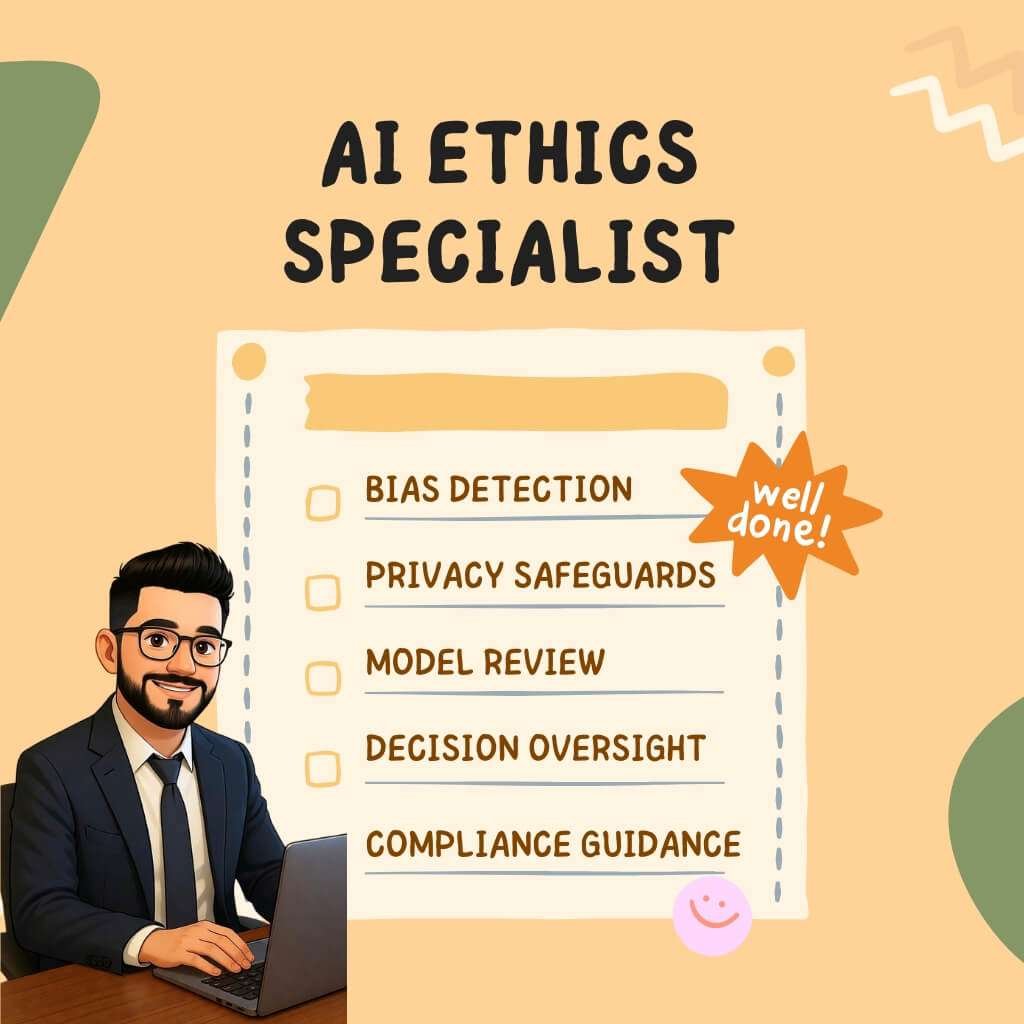
An AI ethics specialist checks data, models and decisions for bias, privacy problems and unclear reasoning.
They work with engineers, lawyers, product teams and leaders. Their job protects users, meets rules and keeps the brand credible.
Why companies and governments hire them
Governments add more AI rules. Companies must comply. More businesses use AI every day. That raises risk and spoils the marketing investment. Bad AI hits the news fast. Companies lose customers and face fines.
Boards and investors now demand proof of AI governance. Firms hire specialists to reduce legal, reputational and financial risk.
How rapid AI adoption created this demand
Big language models run chats, write content and help make decisions. These models can make mistakes.
Hiring tools and workplace analytics can act unfairly. Ethics checks stop discrimination.
Surveillance and law-enforcement tools raise privacy and bias concerns. Ethics pros audit those systems.
Healthcare AI affects patient safety. Ethics oversight keeps care safe and compliant.
These high-impact uses force companies to build ethics teams.
How ethics links to brand trust and lowers risk
Clear ethics work measures customer behaviour and builds trust. Transparent practices reduce public backlash.
Firms that show audits and reports win investor confidence. Ethics work cuts fines and lawsuits. It helps products gain user acceptance faster.
Why is this now a leadership role
1 . AI affects whole companies. Ethics must reach the top.
2 . Boards set AI governance and risk appetite. Ethics specialists advise them.
3 . Firms form ethics or AI governance committees.
4 . The role now shapes product choices, not only audits them.
5 . Specialists often report to senior leaders or the C-suite.
What Does an AI Ethics Specialist Do Day-to-Day?
They run risk checks on AI projects. They write rules and review processes for using AI. They join product and engineering meetings.
They lead investigations when AI fails. They track new laws and update company policy. They train staff on safe AI use.
1 . Risk assessment: spotting bias, discrimination and data misuse before release
They check new AI projects early. They look at datasets, model outputs and decision flows. They ask:
a) Does the model favour one group unfairly?
b) Does it use data it shouldn’t?
c) Could it break privacy laws?
For example, using the toolkit Aequitas to detect bias in models.
They produce reports with findings. They propose fixes like removing biased data or adding extra tests. This sets up safe release.
2 . Framework creation: writing internal “AI responsibility”
They write company policies for ethical AI use. These policies define:
a) Who reviews AI models before deployment?
b) Which fairness checks to run?
c) How must data be handled?
d) How must decisions be explained?
So, they update the frameworks when laws or tools change.
3. How ethics teams work with data scientists and policy leads
They join meetings with product, engineering, legal and risk teams. They translate ethical concerns into technical tasks. They help engineers ask the right questions, like:
a) “Does this algorithm treat all groups equally?”
b) “Can we explain this decision to a user?”
They work with product teams to map AI features with ethical impacts. They work with policy teams to align with legal standards. This teamwork helps keep ethics embedded, not tacked on later.
4. What happens when AI harms users or breaks laws
When an AI system misbehaves—say it unfairly rejects loan applications—they spring into action. They:
a) Investigate the failure.
b) Trace which component made the bad decision.
c) Report findings to senior management and stakeholders.
d) Suggest remediation: retrain the model, change data, update rules.
They also recommend communication to users, regulators or auditors if needed. Handling incidents fast and properly protects the business and users.
5. How human-centric touch balances innovation vs. harm prevention
They don’t just say “No” to AI. They ask: “How can we use this AI while keeping people safe?”
They help teams move forward with new features but pause when risks go too high.
They listen to user stories. They consider impact on real people, not just tech metrics.
They make ethics a partner in progress, not a barrier.
How do they decide what’s ‘ethical’ in AI?
They use a mix of rules, values and context.
1 . They check legal standards (e.g., privacy laws, discrimination laws).
2 . They check organisational values (fairness, transparency, accountability).
3 . They assess the context: who uses the AI? who gets affected? What decisions are made?
4 . They look at data and model behaviour: is there bias, mis-treatment, opaque logic?
They then judge if the AI is safe, fair, transparent and aligned with values. If not, they revise or delay it.
6. Audit tools, ethical LLM evaluation and explainability dashboards
Ethics specialists use AI tools to catch bias and ensure fairness. Dashboards and LLM evaluations make AI more transparent.
Audit tools
The market for AI oversight tools grows. Businesses deploy tools for model explainability, fairness checks and audit trails.
Explainability dashboards
These let teams view how AI made a decision. For example, dashboards turn “black-box” models into visible workflows.
Ethical LLM evaluation
Large language models (LLMs) get tested not just for accuracy but for bias, misinformation and fairness. Ethics specialists lead these tests.
Continuous monitoring
After deployment, AI systems get ongoing checks for drift, unintended consequences and fairness degradation. This has become standard.
Expert view
“Ethics work in AI must start at design and keep running through deployment. Oversight cannot wait until after harm occurs.” From “Trends in AI Governance and Ethics for 2025” by Giles Lindsay.
Case Study – Microsoft’s Fairness & Transparency Toolkit
Microsoft created a team to audit how its AI models impact people. They built an internal dashboard that visualises model decisions and flags fairness issues.
They ran project-by-project risk reviews before release. They also created a response protocol for harms or unexpected outcomes (see Microsoft documentation on responsible AI).
What Skills Make You a Strong AI Ethics Specialist?
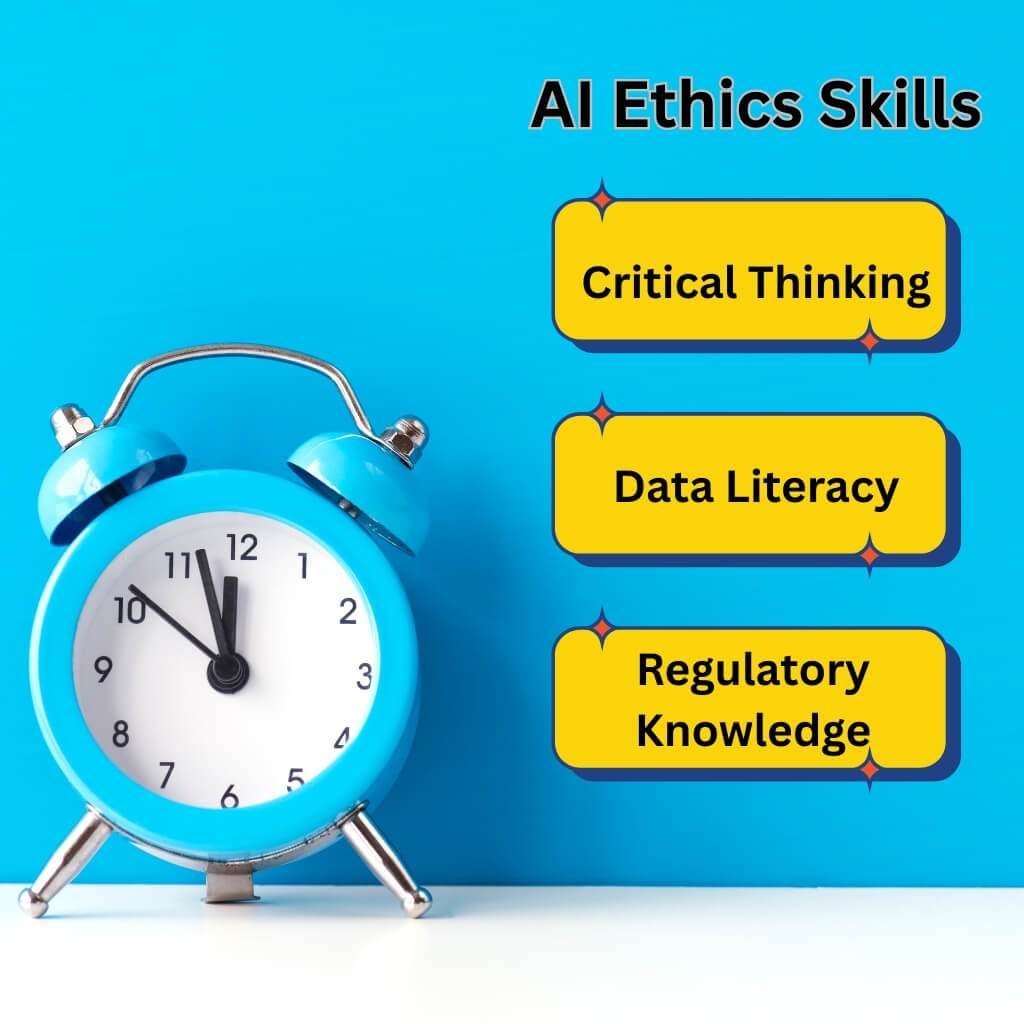
This job didn’t exist a decade ago. It now sits at the centre of AI projects in the U.S. and Europe.
Companies want people who can question data choices, explain moral risks and still talk business.
You don’t have to be an engineer, but you must think like one when ethics meets code.
A . The mix that defines the role
An effective ethics specialist blends three kinds of literacy:
1 . Moral reasoning — how to weigh fairness, privacy and harm.
2 . Legal awareness — how to read and apply AI-related laws and company policies.
3 . Technical fluency — how AI models behave and where risks start.
Companies prefer hires who can link these three into daily decisions instead of treating ethics as theory.
B. Skills employers list in new job postings
LinkedIn hiring data shows a 34 % rise in postings that include “AI ethics” or “responsible AI.” Most of these jobs sit inside U.S. tech, healthcare and finance firms. The major skills are:
1 . Data awareness — You must read bias metrics, model audit logs and dataset notes.
2 . Ethical analysis — You must turn vague moral ideas into review steps.
3 . Policy reading — You must interpret rules from regulators and convert them into company action.
4 . Decision writing — You must write clear, short reports that executives actually read.
5 . Human insight — You must see beyond numbers and ask how AI affects a person’s life.
C. Education and background
There’s no single degree path. Employers hire people with backgrounds in philosophy, law, computer science, data policy and even journalism.
What matters is evidence of clear judgment, pattern spotting and communication skills. Postgraduate programs in “Tech Ethics” at MIT, Stanford and Oxford are now full for each intake.
Online courses from Coursera, edX and Microsoft’s “Responsible AI Track” fill the gap for mid-career workers.
D . Certifications are now valued by recruiters
The certification space matured quickly today.
1 . IEEE CertifAIEd — formal training in ethical system design and audit methods.
2 . Responsible AI Certification (UC Berkeley) — focused on policy, bias and governance.
3 . ISO/IEC 42001 — framework for AI management systems; many companies now require staff familiar with it.
4 . AI Governance Professional by ForHumanity — growing among consultants and compliance leads.
5 . NVIDIA Responsible AI Badge — launched in 2025 for AI project managers working with generative tools.
Holding even one of these helps candidates stand out in corporate hiring panels.
How specialists stay current
Ethical standards shift fast. Specialists join working groups at the IEEE, World Economic Forum and NIST.
They read AI incident reports and update checklists monthly. They use audit dashboards like Truera, CredoAI and Fiddler to review model fairness and traceability.
The newest skill in demand is “model card writing”. These concise summaries explain how and why a model makes decisions.
Can you become an AI ethics specialist without coding skills?
Yes, but you must speak tech. You should know what training data means, how models drift and what bias metrics show. You don’t need to code, but you must ask engineers the right questions.
People from journalism, psychology and law now enter this field after short technical bootcamps. The goal isn’t coding, it’s translation between humans and machines.
Expert insight
“Ethics jobs are no longer side roles. They are hybrid positions that join strategy, compliance and empathy in one desk.” Francesca Rossi, IBM Global AI Ethics Leader, interview with MIT Technology Review.
Case study — IBM’s AI Ethics Board
IBM created a central ethics board in 2025 to align product reviews with new AI laws.
The board includes lawyers, philosophers, data scientists and social researchers.
Each new model goes through a fairness and accountability check before launch.
IBM also trains outside partners using the AI Ethics Toolkit, a public resource released.
The program cut compliance investigation time by 22 % and improved public trust scores in client surveys that same year.
The Future of the AI Ethics Specialist Role
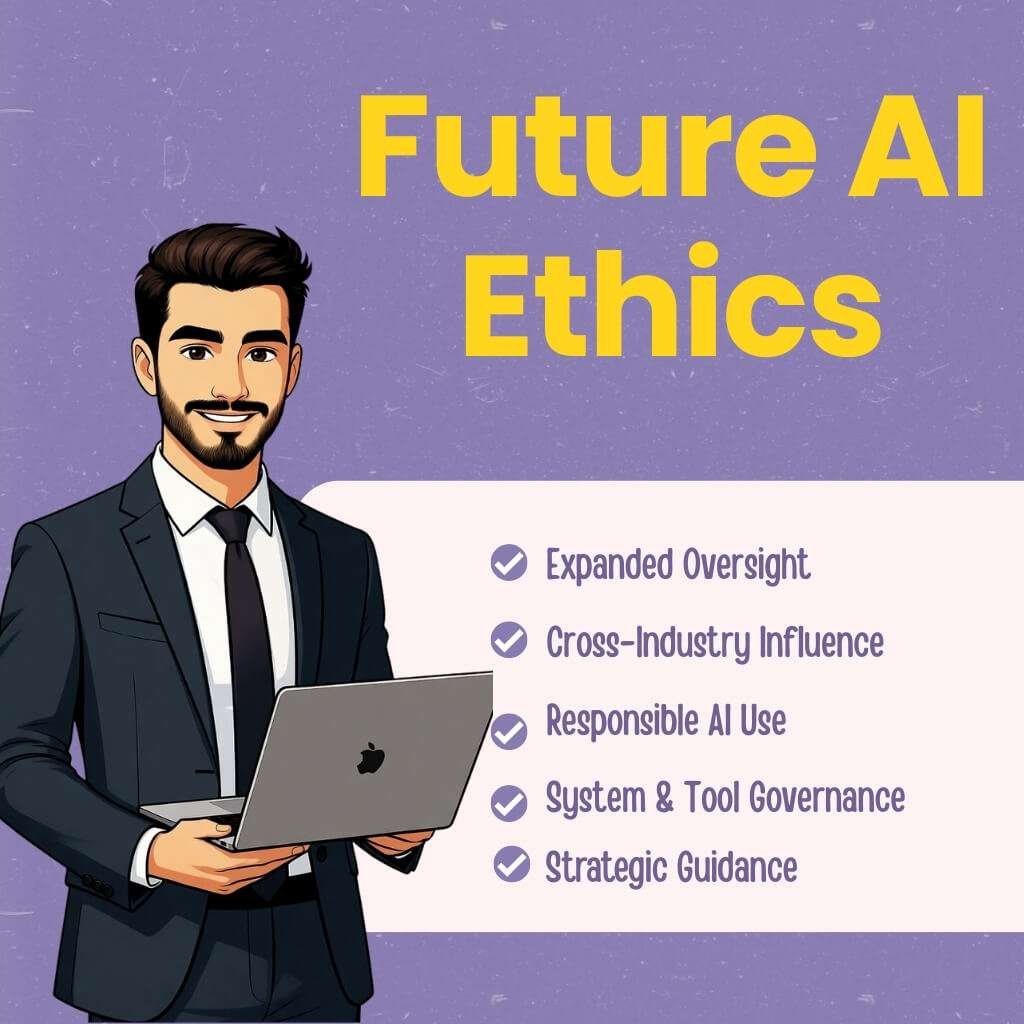
AI Ethics Specialists are taking bigger roles in companies. They guide AI use and make sure it stays responsible. By 2026, they will oversee AI tools, systems and decisions across industries.
Evolving into broader governance and trust functions
1 . The role will shift from single-project ethics reviews to end-to-end oversight of AI operations.
2 . Ethics specialists will join “Trust & Safety” teams alongside compliance, privacy and legal.
3 . They will lead governance of AI pipelines, vendor models and partner integrations—not just internal models.
4 . They will craft dashboards for board-level visibility showing ethics metrics, vendor risk and audit logs.
The global governance market is set to reach USD 5.8 billion by 2029 at a CAGR of ~45 % from 2024.
5 . Their role will become strategic: linking ethics to business decisions, digital strategy and partner ecosystems.
High-demand sectors for 2026 and later
1 . Healthcare & life sciences: AI for diagnostics and treatment will need deep oversight for bias, safety and clinical risk.
2 . Financial services: Models for credit, fraud and investment must satisfy both ethics and regulation; growth is high.
3 . Education & workforce: Personalized learning and hiring systems will draw an ethics review.
4 . Public sector/defence/infrastructure: Autonomous systems, surveillance and AI in government will demand ethics leadership.
Sector forecasts show regulated industries are the fastest adopters of governance tools.
Rise of “Ethics as a Service” providers
1 . External firms now offer ethics audits, vendor-model risk assessments, governance frameworks and training.
2 . These providers plug gaps where companies lack internal teams or need rapid scale.
3 . Market growth in governance tools signals demand for these service firms.
4 . Ethics specialists may increasingly manage vendor relationships and audits rather than handle all tasks internally.
Impact of Generative AI and autonomous systems
1 . Generative AI models now create text, code, images and decisions.
2 . Autonomous agents will act across domains (logistics, customer service, operations) with minimal human input.
3 . Ethics work will expand to include supply-chain models, third-party APIs and the chain of decision-flows.
4 . Model monitoring and governance will shift from point-in-time reviews to continuous oversight, because agents evolve.
5 . Ethics specialists will need to manage “model of models”, audit tools and meta-governance corridors.
Will AI ethics specialists be replaced by AI tools?
No, tools will assist, not fully replace.
AI tools will automate audits, flag bias, track drift and generate reports.
But human judgment will remain essential for context, value trade-offs, stakeholder dialogue and cultural issues.
Boards, regulators and the public expect human oversight and accountability.
Ethics specialists will move toward roles where they direct tools, interpret results, set strategy and handle nuances that machines miss.
Why human judgment remains irreplaceable
1 . Humans interpret values and decide priorities among conflicting ethical principles.
2 . Humans navigate ambiguous cases where rules don’t exist or apply differently by culture and domain.
3 . Humans communicate with stakeholders, explain decisions, build trust and handle reputational risk.
4 . Ethical decisions often involve trade-offs: human insight needed to weigh company goals, user rights and societal impact.
5 . Regulators and users demand human accountability — a machine alone cannot respond to complex stakeholder concerns or policy shifts.
Expert insight
“As AI systems become more autonomous and embedded, governance cannot be an afterthought. We are entering a phase where ethics teams must frame entire AI ecosystems.” From “8 AI Ethics Trends That Will Redefine Trust” (Forbes, Oct 2025) forbes.com
Conclusion
An AI ethics specialist is the strategist behind every AI decision. They balance risk like a stock portfolio. Ethical AI builds trust like a premium brand. Fair systems operate like top-performing assets. Their guidance turns uncertainty into profit.
FAQ
What new AI tools will ethics specialists use in 2026?
They will use dashboards that check AI models for bias and errors. They will also use tools that track compliance automatically. These tools help specialists spot issues before AI systems go live.
How will AI ethics roles intersect with cybersecurity in 2026?
Ethics specialists will work with security teams to prevent AI misuse. They will review AI systems to avoid data leaks and hacking. Their work ensures AI does not create new security risks.
Will AI ethics specialists influence AI-driven marketing campaigns?
Yes. They will check AI-generated ads and content for fairness and truthfulness. They make sure campaigns do not mislead customers or break regulations.
How will ethics specialists measure the societal impact of AI in 2026?
They will track how AI affects inclusion, accessibility and public trust. They will also check environmental impact and misinformation risks. This helps companies make AI responsible and safe.
Will AI ethics specialists need financial literacy skills?
Yes. They will understand budgets, cost risks and financial compliance for AI projects. This helps them guide companies in investing responsibly in AI technology.
Can AI ethics specialists help design human-centered AI interfaces?
Yes. They will guide teams to create user interfaces that respect privacy and cultural norms. They ensure AI tools are easy to use and do not harm users.
Will AI ethics specialists work with external regulators directly?
Yes. They will prepare reports and answer questions from regulators. They help companies meet new international standards and avoid fines.
How will ethics specialists track AI updates in 2026?
They will use model registries and version control tools to monitor AI changes. This ensures every update stays compliant and ethical.
Will AI ethics specialists engage in AI public education?
Yes. They will teach employees and communities how to use AI responsibly. This builds awareness and increases trust in AI technologies.
How will ethics roles influence AI vendor selection in 2026?
They will evaluate third-party AI tools for fairness and transparency. This ensures vendors meet the company’s ethical standards before use.

Aliza Khatun is a Digital Marketing Professional and the founder of DigiGenHub. She has helped various businesses grow their online presence through real-world experience in marketing, branding, traffic growth, and business strategy.
Through DigiGenHub, she shows how to build and grow a business from the ground up using Website Setup, SEO, Branding, Paid Promotion, and smart digital tools.
She also highlights how AI can be used to its full potential to make content creation, automation, marketing, and business growth faster and smarter.
She believes that the right knowledge, modern technology, and the right tools can help any individual or business build a stronger online presence.