

Slow updates and repetitive tasks waste time, cost traffic, leads and resources. So, perceive the types of LLM to avoid delays or errors in content, customer communication, or data handling.
Using the right type saves time, improves accuracy and keeps customers satisfied.
Yet, I helped a friend who runs an online dropshipping store. He struggled to write product descriptions, update listings and respond to customers on time.
We used different Types of LLM. A GPT model created engaging product copy. A RAM model pulled the correct stock and pricing details.
A VLM generated clear product images. Orders went up. Customer questions got answered faster. His team could focus on promotions instead of rewriting content.
How to Classify the Different Types of LLM?
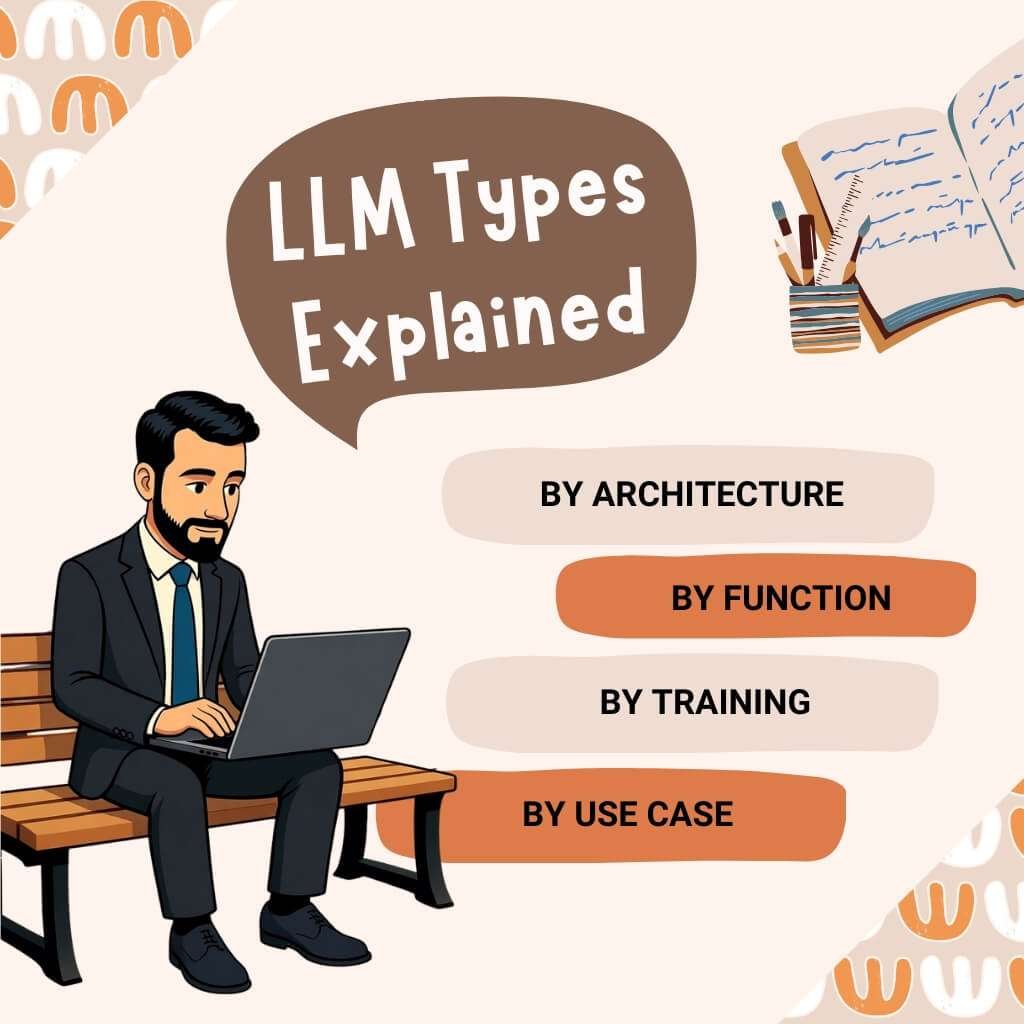
LLMs are now split into three main types by architecture, function and training.
By architecture – how the model is built and processes data.
By function and specialization – what the model is designed to do.
By training and data modality – how the model learns and what data it uses.
Most modern AI systems mix more than one type. For example, OpenAI’s GPT-4V combines decoder architecture, multimodal training and retrieval-based grounding.
This mix helps it handle writing, reasoning and visual inputs all in one system.
AI tools no longer rely on a single “big model.” Instead, they use a stack of model types. The large reasoning models for thought, small local models for privacy and retrieval layers for accuracy.
Know how these types work helps businesses and professionals. Choose the right model for content, coding, or analysis.
Now, let’s look at each category step by step.
1) By Architecture — How the model thinks and creates
LLMs come in three main architectural designs. Each one serves a different goal.
a) Encoder-only
Reads and represents input.
Best for: text classification, search, sentiment detection.
Examples: BERT, RoBERTa.
b) Decoder-only
Writes text from scratch, token by token.
Best for: chatbots, creative content, copywriting.
Examples: GPT, LLaMA, Claude.
c) Encoder-decoder (Sequence-to-Sequence)
One side reads, the other writes.
Best for: translation, summarization, or complex document conversion.
Examples: T5, Gemini 1.5 and some hybrid open-source models.
Which architecture works best for content, coding, or analysis?
Content: Decoder-only gives fluent and natural writing.
Coding: Decoder-only or hybrid models predict and fix code better.
Analysis: Encoder or encoder-decoder captures meaning and context precisely.
2) By Function and Specialization — What the model actually does
Modern LLMs are now built for specific roles. Below are the eight main types trending through:
GPT (Generative Pre-trained Transformer) – Writes or answers in natural language.
MoE (Mixture of Experts) – Routes tasks to specialized “expert” mini-models.
LRM (Large Reasoning Model) – Solves logic-heavy, multi-step problems.
VLM (Vision-Language Model) – Handles both text and images.
SLM (Small Language Model) – Compact and runs locally on devices or private servers.
LAM (Large Action Model) – Turns text into real actions (like running an API or sending a file).
LCM (Large Concept Model) – Understands abstract or conceptual relationships.
RAM (Retrieval-Augmented Model) – Combines external databases with an LLM for factual accuracy.
Which type is most used in AI tools right now?
Most tools still rely on GPT-style decoder models for content and chat.
But recent trends show growth in RAM (retrieval) and SLM (small model) adoption. These are congenial in corporate and on-device environments.
Why are companies shifting toward smaller or hybrid models?
Cost: Smaller models cut inference costs dramatically.
Privacy: Local models keep sensitive data off the cloud.
Control: Companies can blend open-source and closed models to balance accuracy and compliance.
3) By Training and Data Modality — How the model learns and what it can handle
Training defines what a model knows and how it behaves. There are four major types in use:
Zero-shot models – General-purpose. Handle many tasks without extra training.
Fine-tuned models – Trained on specific domains like finance, law, or healthcare.
Multimodal models – Process text, images, video, or audio in one system (e.g., GPT-4V, Gemini 1.5).
Code models – Focused on programming tasks, bug fixes and software generation (e.g., Codex, StarCoder).
How does the training method affect accuracy and bias?
Fine-tuning improves focus but can introduce bias if the training data is narrow.
Retrieval (RAG) improves accuracy by connecting responses to real documents.
Multimodal models see more context but also inherit bias from visual and audio datasets.
The most balanced results come from hybrid pipelines — fine-tuned, retrieval-grounded and human-reviewed.
Case Study
Company: Allpay (UK-based financial tech, Microsoft partner)
Use: GitHub Copilot and OpenAI Codex stack
Result: Developers reported faster onboarding and about 10% workflow improvement.
Insight: Code-specialized models deliver measurable gains even in regulated industries.
Source: Microsoft Customer Story – Allpay
Expert Insight
“Open-source LLMs let teams build models that fit their rules, not someone else’s.” Clément Delangue, CEO, Hugging Face
What Are the Most Prominent LLM Types?
Small businesses use Mixtral, Phi-3, or SLMs for low cost and local deployment. Mid-sized firms choose LLaMA 3 and Command‑R for balance.
Large enterprises rely on GPT‑5, Claude 3 and Gemini 1.5 for scale and advanced features.
Types of LLM and Budgets
| LLM Type / Model | Best Use Case | Deployment Option | Typical Monthly Cost |
| GPT-4.5 / GPT-5 (OpenAI) | Advanced reasoning, content, coding | Cloud (API / ChatGPT Enterprise) | $60–$120 per user or $20K+ Enterprise |
| Claude 3 (Anthropic) | Context-heavy writing, legal, policy | Cloud via Anthropic or Bedrock | $45–$80 per user or $10K+ Enterprise |
| Gemini 1.5 Pro / Flash (Google) | Multimodal content, marketing, media | Google Cloud AI Studio / Vertex | $50–$150 per user or $15K–$30K API |
| Mixtral 8x7B (Mistral AI) | Coding, automation, open research | Self-hosted / cloud hybrid | Free (open) + $1K–$5K infra |
| LLaMA 3 (Meta AI) | Internal AI assistants, private R&D | On-premise / private cloud | Free (open) + $3K–$10K infra |
| Command-R (Cohere) | Document retrieval, Q&A bots | Cloud via Cohere Platform | $2K–$10K usage range |
| Phi-3 (Microsoft) | Productivity AI, Copilot apps | Azure OpenAI Service | Included in suite or $5K–$12K API |
| SLMs (General) | On-device AI, private data tasks | Local / edge / private server | $500–$2K infra |
| VLMs (Gemini / OpenVLM) | Visual search, creative assets | Cloud + edge | $8K–$20K Enterprise |
| LAMs / Reasoning Models | AI agents, task automation | Hybrid cloud / API | $10K–$40K per deployment |
1. Commercial Giants
These are leading model families backed by major AI players.
GPT‑4.5 (by OpenAI)
Released as research preview on February 27 2025.
Trained with larger datasets and improved supervision.
Early results show enhanced pattern recognition and fewer hallucinations. Reuters+1
Yet, firms using OpenAI APIs or ChatGPT Pro can access a top-tier general model now.
Mixtral 8x7B (by Mistral AI)
Open-weight sparse mixture-of-experts model was released in 2024 with strong benchmarks. InfoQ
Context length 32k tokens; performance on code, reasoning benchmarks outpaces some larger models. Arize AI
For businesses wanting open-source alternatives for licensing, on-premise use, or cost control.
2. Open-Source & Enterprise Models
These models give businesses more control—from deployment to adaptation.
LLaMA 3 (by Meta Platforms)
Meta’s model line is aimed at research and enterprise adjustments.
Enterprises looking for flexibility outside closed-cloud systems can use it.
Command‑R (by Cohere AI)
Retrieval-enhanced model designed for tasks involving company data or large document sets.
In regulated industries (finance, legal), retrieval models help reduce misinformation and tie outputs to real sources.
Phi‑3 (by Microsoft)
A compact model variant targeting efficiency and enterprise usage.
Medium-sized firms that cannot deploy monster models get a workable alternative.
3. Hybrid / Niche Model Trends
These model types solve specialized needs.
Reasoning-first models (for example, models fine-tuned for logical chains, planning and agents).
Use-case: Automating workflows, multi-step decision systems and enterprises needing “explain-how” outputs rather than just “what”.
Firms deploying bots for compliance, audits, or procedural automation won’t use generic models only.
Small Language Models (SLMs) for privacy-first use
These run on device, on-premise, or edge.
Companies with sensitive data (healthcare, legal, government) adopt SLMs to keep data internal.
Vision-Language Models (VLMs) in creative/product fields
Models that mix images/video + text capabilities.
Use-case: E-commerce, creative agencies, product design tools.
Businesses beyond pure text generation now need models that “see and speak”.
Expert quote
“Open-weight models now level the competitive field for businesses. It’s no longer only large cloud vendors who can deploy advanced LLMs.” Research team at Mistral AI, on Mixtral’s release and open-source trend. dataforest.ai
How to Choose the Right Type of LLM: What Fits Your Needs?
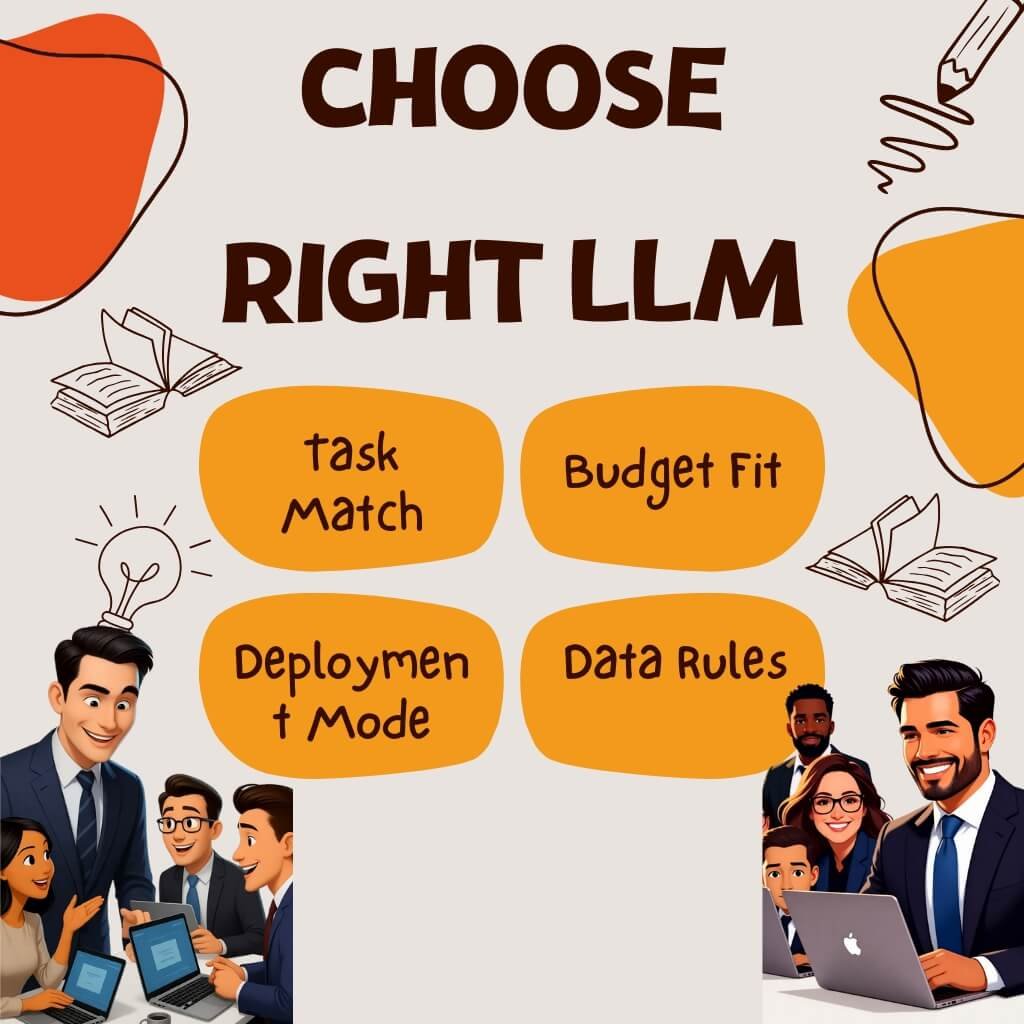
Select your LLM type by matching your task, budget, deployment and data rules.
Which LLM is best for business use?
Look for models with enterprise support, security features and good licensing.
Cloud API models like GPT‑4.5 or Claude 3 often fit business needs because they offer large context windows and vendor services.
For firms with strict budgets or in‑house systems, open‑source models like Mixtral 8×7B provide cost control and deployment flexibility.
Use case matters: For customer service chatbots, go with cloud‑API models. For internal document summarization, an on‑premise or hybrid stack works better.
Example: A16Z’s 2025 survey found many enterprises using 5+ models in production to match different uses. Andreessen Horowitz
Which one is fastest for local or private tasks?
If you need minimal latency or data stays on‑site, choose a Small Language Model (SLM) or a trimmed version of a larger model.
On‑device or private‑cloud models cut dependency on external APIs.
Also, look for models optimized for inference and lower compute cost.
Deployment options: Private server, edge device, or secure cloud region.
Which models give the best reasoning results?
Reasoning means multi‑step logic, planning, justification—not just fluent text.
Models built for reasoning often include retrieval, chain‑of‑thought and dedicated fine‑tuning.
Many enterprises pick models supporting Retrieval‑Augmented Generation (RAG). So the model can “look up” facts rather than rely solely on internal weights.
For rigorous tasks (audits, compliance, legal), go with models fine‑tuned for reasoning plus external grounding.
Example: Agentic‑AI and workflow models shift focus toward “AI agents” that reason and act. AI News
Be conscious of cost, data privacy, performance and scalability
You can judge four questions to get the answer:
Cost: What is your budget for licensing, infrastructure, inference and support? 2025 spend data: API usage alone jumped from ~$3.5B to ~$8.4B in six months.
Data privacy: Will your data stay on-premises? Must you adhere to regulation (HIPAA, FINRA, etc.)? If yes, consider private models.
Performance: Does the model meet accuracy, latency and reliability thresholds for your use case?
Scalability: Can the model and deployment scale as your business grows? Do you need multi‑model stacks? Many enterprises now use hybrid stacks.
Also ask: How often will you update or maintain the model? What governance and compliance systems are in place?
Rise of LLMs as agents, hybrid models and on‑device AI
More businesses adopt AIagents—models that act (trigger workflows, connect to apps) rather than just reply.
Hybrid model stacks (mix big cloud model + small local model + retrieval layer) become standard for optimized cost + performance.
On‑device AI (SLMs) grows rapidly in sectors needing data protection or offline capability.
As one trend report noted, “model differentiation—not commoditization—is the driver” for enterprise LLM adoption.
Also, watch interoperability standards like the Model Context Protocol (MCP) that help integrate LLMs with tools and data. en.wikipedia.org
Expert note
Enterprises now mix models. They assign each task to the model best suited for it.” Enterprise AI survey
SLM (Small Language Model) handles private or low‑latency tasks.
RAM (Retrieval‑Augmented Model) ensures accurate, grounded responses.
LRM (Large Reasoning Model) takes on complex logic‐heavy workflows.
Why Are New Types of LLM Emerging So Fast?
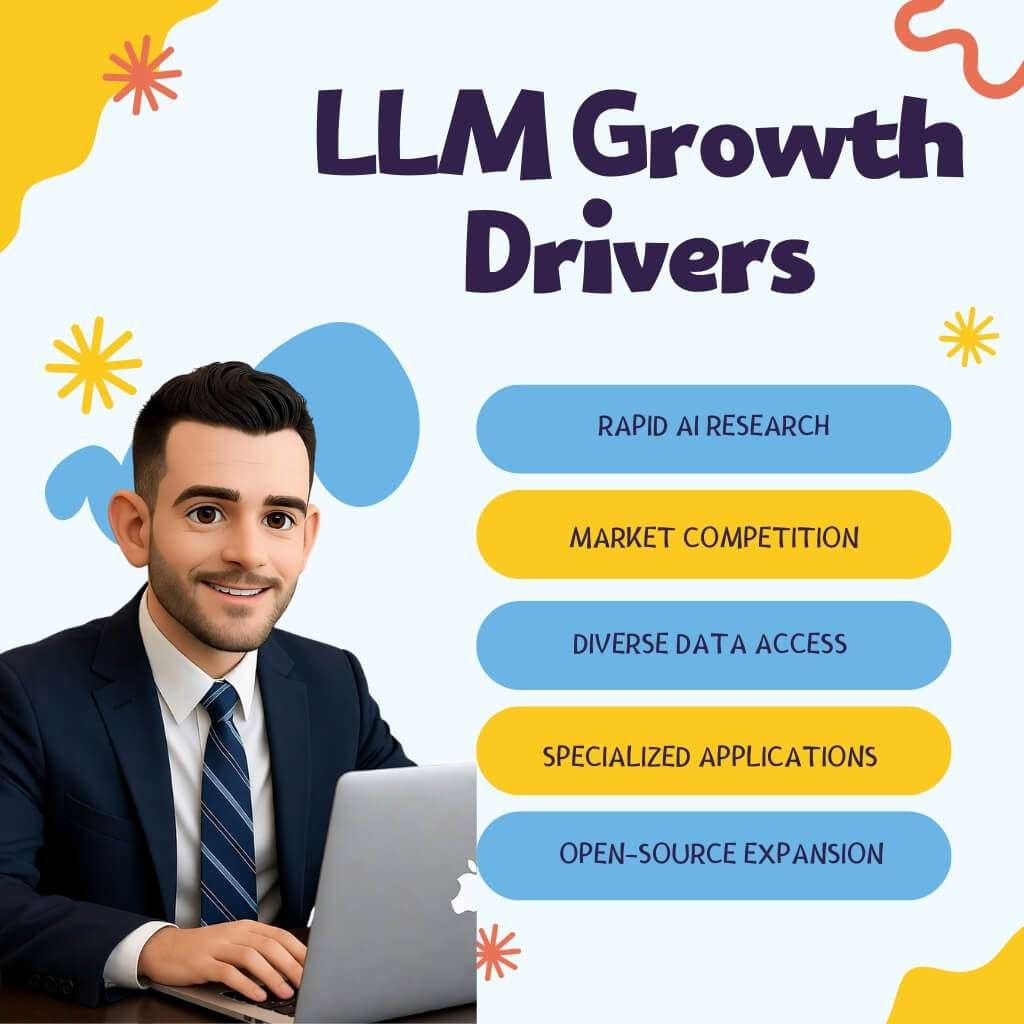
Several forces are driving the explosion of new LLM types.
Different business goals
A hospital, a law firm and a retail brand need different AI skills. So models evolve for coding, legal text, medical summaries, or creative writing.
Cost pressure
Running a single massive model is expensive. That’s why engineers design smaller or modular ones — such as Mixture-of-Experts (MoE).
Inference cost for GPT-3-level performance dropped over 280-fold between late 2022 and late 2024. (Stanford HAI 2025 Report)
New media formats
Users want models that see, hear and respond across formats. That led to Vision-Language Models (VLMs) and Large Action Models (LAMs).
Open-source competition
Publicly released models from Meta, Mistral and others push innovation faster. Developers adapt them for every niche.
Privacy and regulation
U.S. firms, especially in finance and healthcare, want secure and local deployment. That fuels Small Language Models (SLMs) built for private servers or edge devices.
Rapid innovation loops
With more talent and funding, new LLMs appear monthly. According to StartUs Insights, the sector’s annual growth rate now exceeds 100%.
Business Relevance: Cost, Performance and Access
This wave matters most for U.S. businesses.
Lower entry cost
Smaller and open models make AI adoption affordable. Mid-size firms can now deploy their own LLMs without deep pockets.
Higher accuracy
Reasoning-based models reduce factual errors and improve complex tasks like coding or legal review.
Specialization
Industry-specific models — legal, finance, medical — deliver better precision than general ones.
Flexible setup
Companies can choose cloud APIs, private hosting, or on-device models depending on compliance rules.
Competitive gain
Early users of focused LLMs save time, cut costs and move faster.
67% of organisations worldwide already use LLMs in daily operations.
Market scale
The U.S. LLM market alone could hit $31 billion by 2034. (Precedence Research)
These shifts show why knowing each type of LLM matters. Choosing the right one decides how much value a company can pull from AI.
Case Study: JPMorgan Chase & Co
JPMorgan rolled out an internal LLM suite to help more than 60,000 employees.
It assists with document summaries, code generation, translation and report drafts. The system sits within their secure network, keeping data private.
Conclusion
Think of your business as a busy office. Each Type of LLM is a specialist—GPT writes, VLM designs, RAM organizes data. The right mix works like a strong portfolio—balanced, efficient and ready for growth.
FAQ
Can LLMs generate legal or regulatory summaries automatically?
Specialized LLMs will handle legal datasets. They can create concise summaries of legislation, contracts and regulations. Executives can review them quickly.
Will LLMs replace human analysts in market research?
LLMs will scan large datasets. They can spot trends and patterns. Humans will still interpret the results and make strategic decisions.
How are LLMs expected to support creative industries?
LLMs will help produce storyboards, marketing scripts and product concepts. They can use text and visual inputs. Creative teams get faster idea generation.
Can LLMs help with internal knowledge management in large companies?
Yes. LLMs can index internal documents. They provide instant insights. They can do this without sharing sensitive data externally.
Will new LLMs understand regional languages or dialects better?
Yes. Models are trained on diverse U.S. datasets. They understand slang, multicultural expressions and regional languages accurately.
How will LLMs influence product design and prototyping?
LLMs can suggest design ideas. They recommend improvements. They can simulate user interactions using text and images.
Are there models specialized for educational content generation?
Yes. Emerging LLMs can create curricula, quizzes and learning materials. They adapt content to student needs.
How will LLMs help with sustainability and ESG reporting?
LLMs can analyze environmental, social and governance data. They generate reports that meet compliance standards.
Can LLMs predict industry trends or consumer behavior?
Yes. Predictive LLMs simulate market scenarios. They use historical and current data. This helps businesses forecast trends.
Will LLMs integrate with AR/VR experiences by 2026?
Yes. LLMs will power conversational avatars. They can act as guides in augmented or virtual reality. Applications include training, marketing and entertainment.

Aliza Khatun is a Digital Marketing Professional and the founder of DigiGenHub. She has helped various businesses grow their online presence through real-world experience in marketing, branding, traffic growth, and business strategy.
Through DigiGenHub, she shows how to build and grow a business from the ground up using Website Setup, SEO, Branding, Paid Promotion, and smart digital tools.
She also highlights how AI can be used to its full potential to make content creation, automation, marketing, and business growth faster and smarter.
She believes that the right knowledge, modern technology, and the right tools can help any individual or business build a stronger online presence.