
AI product recommendations act like a personal shopper for every customer. These new AI engines use data from what you browse and what you buy.
They even use data you share willingly. This makes online stores feel personal. Every visit is a unique experience.
For a fast track to success, businesses need the right tools. Platforms like Dynamic Yield, Nosto, or Google Cloud Recommendation AI are essential.
These tools help measure success with clear metrics. They also ensure data privacy and ethics. This is how you build customer loyalty. This amplifies revenue by up to 40%. It also secures a 3x increase in brand valuation.
AI Product Recommendations
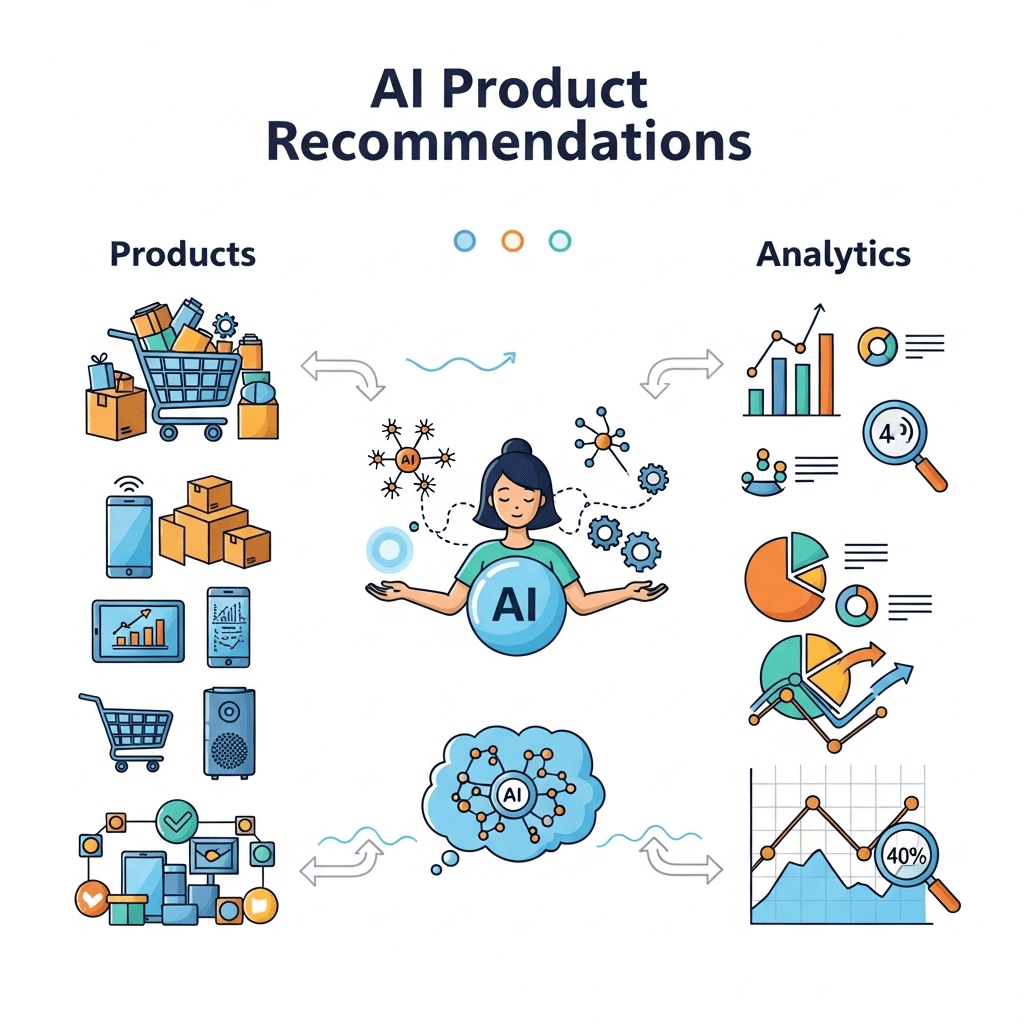
You may ask, how is the AI recommendation different from traditional systems? Old systems used simple rules like, “customers who bought this also bought that.”
They were rigid. They often missed what made people unique. They were like a one-size-fits-all t-shirt. It improves your business and public relations.
An AI learns and changes with every interaction. Let’s justify the comparision:
Real-time adaptation
Old systems were slow to update. AI systems are instant. They react to a click in a fraction of a second. This is like a friend suggesting a restaurant right when you say you’re hungry for something specific.
Deeper understanding
AI sees the full story. It knows the context. It understands that a gift purchase doesn’t mean a customer wants similar items for themselves. It also helps new users by making smart initial suggestions right away.
Predictive power
Old systems were reactive. AI is predictive. It uses complex math to guess future interests. It recommends items a customer didn’t even know they wanted. This is a game-changer for discovery and loyalty.
Why is real-time AI personalization crucial for e-commerce profit?
People expect an instant experience. Let’s explain:
Elevated Customer Loyalty
It creates a strong connection. Brands that offer this build a loyal base besides marketing.
Increased Conversion and Revenue
When a customer sees a product they want, they buy it. Real-time AI puts the right product in front of them at the perfect moment.
Competitive Advantage
The market is crowded. Real-time personalization is no longer a luxury. It’s a necessity. Businesses that master this technology stand out.
What are the AI-driven trends that upturn the e-commerce zone?
Personalization is a core business philosophy. Let’s discuss why:
Conversational Commerce
Shopping is becoming a conversation with AI assistance. AI chatbots and virtual assistants use natural language. They recommend products based on a chat. A customer can ask, “What are the best shoes for hiking?” The AI gives a quick answer. This mimics a real store interaction.
Hyper-Personalization with Zero-Party Data
First-party data is what you collect. Zero-party data is what a customer willingly shares. Brands are now using quizzes and surveys to get this data. The AI uses it to make very precise recommendations. A beauty brand might ask about skin type. This builds trust and gives the best results.
Generative AI for Product Content
Generative AI creates unique content in real-time. It writes product descriptions and ad copy. A customer interested in sustainability might see a description of eco-friendly materials. Another customer might see a description of durability. This makes every message feel one-of-a-kind.
How to implement the right AI recommendation engine for your business?
Implementing an AI for business marketing requires a clear business plan. First, set your goals. Do you want more sales or better engagement? Your goal shapes everything.
Next, gather your data. Data is the foundation. It must be clean and accurate. Bad data gives bad recommendations. Use a mix of what people buy, browse and search for.
Then, choose the right technology. You can build a custom system. Or, you can use a pre-built platform like Dynamic Yield or Nosto. Pre-built tools are often faster and cheaper.
Dynamic Yield’s “Experience OS” optimizes the entire customer journey. (Source: Dynamic Yield)
How to ensure the data for AI recommendations is accurate and privacy-compliant?
Data privacy is a must. Let’s see the solution:
Data Minimization: Only collect the data you need. Don’t hoard information. This lowers the risk of a breach.
Transparency and Consent: Be upfront with customers. Tell them what you collect and why. Get their permission. The EU’s AI Act and other regulations require this. (Source: BigID)
Anonymization and Encryption: Remove personal details when you can. Use strong encryption. This protects data when it’s at rest and when it’s moving.
Regular Audits: Conduct frequent checks on your data practices. Make sure you are compliant with new laws. This is essential in a fast-changing legal world.
How can AI recommendations be integrated into email and ad campaigns?
AI recommendations turn emails and ads into personal conversations. It moves beyond generic messages.
Emails: AI can customize every part of an email. The subject line can be distinctive. The products inside can be tailored to the browsing history.
If a customer looked at sneakers, the AI can send an email with those exact sneakers. It can even time the email perfectly. Statista says 87% of marketers believe AI will be crucial for email campaigns this year. (Source: SuperAgi)
Ads: AI creates dynamic ads for your brand or business to secure sales. These ads change based on who is viewing them. A customer who looked at a jacket might see an ad for that jacket. AI also optimizes ad spend in real-time. It moves money to the best-performing ads. This boosts ROI.
Metrics to Track Success with AI Product Recommendations
Tracking success is crucial. Metrics show if your AI is working.
Click-Through Rate (CTR): The percentage of people who click on a recommended product. A high CTR means recommendations are relevant.
Conversion Rate: How many people who click on a recommendation actually buy it? This is a direct measure of revenue.
Average Order Value (AOV): If recommendations lead to bigger sales. It shows if customers are buying more than they planned.
Customer Lifetime Value (CLV): A customer’s total revenue over time. Good recommendations build loyalty and increase a customer’s long-term value.
How to measure the ROI of an AI recommendation engine?
ROI proves your AI is a modish business choice. The formula is: (Benefits – Costs) / Costs x 100.
Costs: Include everything. Software price, data storage and staff training. Don’t forget maintenance.
Benefits: The extra money you make from the AI. The biggest benefit is higher revenue. It also includes time saved.
Attribution: You must know which sales came from the AI. Use analytics to trace every click and purchase back to a recommendation.
What are the most important KPIs to track for personalization campaigns?
KPIs show if your personalization is on the right path.
Engagement Metrics: How long people stay on your site. How many pages do they visit? This shows if they enjoy the customized content.
Revenue per User: The financial impact of personalization on each person. It’s a powerful indicator of success.
Customer Retention Rate: How many customers you keep. Personalization makes customers feel valued and more likely to return.
Net Promoter Score (NPS): This asks customers if they would recommend your brand. A high score means personalization is making customers happy and loyal.
How can a business continuously optimize its AI recommendations?
Optimization is an ongoing process. It’s not a one-time thing.
A/B Testing: A vital step. Show one group the AI recommendations. Show another standard experience. Compare the results. This proves the AI’s value.
Feedback Loops: Use customer feedback to improve the system. If a customer dislikes a recommendation, the AI learns from that. This feedback is a gold mine.
An AWS blog post describes how a company achieved a 100% accuracy rate by using feedback loops to continuously train and refine its AI model. (Source: AWS)
Model Retraining: AI models need new data to stay smart. Regularly feed the AI fresh data. This keeps it up-to-date with new products and trends.
Real-time Monitoring: Watch your key metrics constantly. If a conversion rate drops, you can catch it fast. This lets you fix problems before they get bigger.
Ethical Considerations and New Standards for AI Recommendations
As AI gets more powerful, ethical concerns grow. Transparency is now a core requirement.
Bias and Fairness
AI learns from data. If the data is biased, the AI will be too. This can lead to unfair recommendations. New standards require companies to check their AI models.
They must ensure data is fair and balanced. Global investments in AI ethics are expected to surpass $10 billion recently.
Explainability
Customers deserve to know why an AI made a recommendation. This builds trust. New standards, like the EU’s AI Act, require transparency. The AI should be able to say, “We recommend this product because you bought a similar item last month.”
Data Privacy
Protecting customer data is crucial. Companies must be clear about what they collect and how they use it. They must get explicit consent. The EU’s AI Act outlines strict rules for high-risk AI. (Source: European Union)
Accountability
Who is responsible if an AI makes a bad decision? New standards are putting the responsibility on the companies that use AI. This forces them to be responsible from the start. Trust is the new currency.
Yet, next, you’ll observe the popular 7 AI product recommendations tool.
1 . Dynamic Yield
It shows each user tailored products or content. AI updates the experience in real time. Built-in testing lets teams see what works best.
Pricing chart
| Plan Tier | Monthly Cost (Est.) | Yearly Cost (Est.) |
| Mid-Market | $2,900 | $35,000 |
| Enterprise | $3,000–$7,000+ | $50,000–$120,000+ |
| Add-ons | $500–$1,500 | $6,000–$18,000 |
| Free Plan | Not available | Not available |
Notes:
Pricing varies by traffic, product use and support level.
Add-ons include onboarding, advanced modules and managed support.
A free trial may be available upon request.
Solution for the challenge:
One-size-fits-all messaging leads to drop-offs.
Dynamic Yield fixes this by showing relevant content.
It boosts engagement, sales and retention.
Integrations & Setup:
Connects with Shopify, Adobe Commerce, Google Analytics, HubSpot, Mailchimp and more.
Setup is tag-based and non-intrusive. Typical deployment takes 4–8 weeks.
Industries & Use Cases
Retail: Upsell carousels, exit intent pop-ups
Travel: Personalized hotel or flight offers
Media/Gaming: Tailored content feeds
Benefit & Limitation
Benefit: Combines personalization, recommendations and A/B testing in one tool.
Limitation: Expensive and complex for smaller teams.
Ethics & Data Use
Follows GDPR and CCPA guidelines.
Supports full transparency and audit logs.
Segmentation and targeting logic are visible and adjustable.
Bias control is manual but effective.
2 . Nosto
Nosto collects shopper data and suggests products.
It customizes site search, recommendations, pop-ups, & emails.
It lets teams run A/B tests for banners and recommendations. Nostoreleasit
Pricing chart
| Plan Tier | Monthly Cost (Est.) | Yearly Cost (Est.) |
| Free Tier | Available | available |
| Paid Tier (small) | ~$800–$1,500 | ~$9,600–$18,000 |
| Enterprise | Custom based on usage | Custom |
Notes:
Free tier supports basic installation with limited features. Nosto charges grow as site traffic and revenue grow.
Paid plans are usage-based and tied to modules like search, recommendations, content and emails.
Enterprise pricing is confidential and negotiable.
Complex issues it simplifies:
General product displays feel irrelevant.
Nosto shows what each shopper cares about.
It increases clicks, conversions and average order value.
Integrations & Setup:
Integrates with Shopify, Magento, BigCommerce, major ESPs and CRMs.
Setup is low-code. Drag-and-drop builder.
Implementation typically takes ~2 months.
Industries & Use Cases:
Retail/E‑commerce: upsell, cross‑sell, product bundles
Fashion/Electronics: smart search and recommendations
Media: particular content tiles and pop-up messages
Benefits & Limitations:
Benefit: Starts free, scales as you grow. Easy to use.
Limitation: Pricing is not transparent. It can get expensive with scale. Advanced customization may need dev skills.
Adherence to ethical guidelines:
Follows GDPR and CCPA rules.
Targeting logic and AI modules are adjustable.
Consent management is built in.
Transparent testing and segmentation reduce bias risk.
3 . Google Cloud Recommendation AI
It uses Google’s ML models to recommend products in real time.
Recommends based on user behavior, product catalog and context.
Handles large-scale personalization with auto-scaling.
Pricing sheet
| Plan Tier | Monthly Cost (Est.) | Yearly Cost (Est.) |
| Pay-as-you-go | ~$0.20 per 1,000 recommendations | Depends on usage |
| Model Training | $2.40 per training hour approx. | Usage-based |
| Free Tier | First 50,000 recommendations free | N/A |
Notes:
Pricing is mostly usage-based—no fixed monthly fee.
Free tier offers 50K recommendations monthly.
Costs increase with prediction volume and model retraining.
Problems it fixes:
Manual recommendations are slow and inaccurate at scale.
Google’s AI adapts to customer preferences instantly.
It helps increase clicks, conversions and order values.
Integrations & Setup:
Integrates natively with Google Cloud Storage, BigQuery and AI Platform.
Requires developers or ML engineers for setup.
APIs are REST-based; SDKs are available for popular languages.
Industries & Use Cases:
Retail: Large catalogs needing dynamic product recommendations.
Media: Subjective content discovery.
Travel: Tailored offers based on browsing and booking patterns.
Benefits & Limitations:
Benefit: Highly scalable and reliable with Google infrastructure.
Limitation: Complex setup; technical skills required. Usage cost can vary widely.
Ethics & Privacy:
Built on Google Cloud’s strong compliance with GDPR, HIPAA and CCPA.
Supports transparency and user data control.
Bias reduction features are available through model tuning.
4 . Monetate
Monetate creates personalized web, email and mobile experiences.
It offers powerful A/B and multivariate testing tools.
It helps marketers find the best content and offers for each visitor.
Pricing sheet
| Plan Tier | Monthly Cost (Est.) | Yearly Cost (Est. |
| Basic | Starting at $2,000+ | $24,000+ |
| Mid-Market | $4,000–$8,000 | $48,000–$96,000 |
| Enterprise | Custom pricing | Custom pricing |
| Free Plan | Not available | Not available |
Notes:
Pricing varies by traffic volume, campaign complexity and support level.
No free tier; custom quotes for large clients. (g2.com, getapp.com)
Issues It Solves
Generic messages reduce conversion rates.
Monetate tests variants to optimize user experience.
It boosts sales by showing relevant offers in real time.
Integrations & Setup:
Integrates with Salesforce Marketing Cloud, Adobe Experience Manager, Shopify Plus and Google Analytics. Setup uses JavaScript tags and APIs. Deployment timelines vary from weeks to months based on complexity.
Industries & Use Cases:
Retail & E-commerce: Homepage personalization, cart abandonment testing
Financial Services: Tailored product offers and content
Travel & Hospitality: Customized booking experiences
Vital Benefit & Limitation:
Benefit: Combines personalization with strong testing capabilities.
Limitation: Can be complex to implement; pricing is on the higher side for small businesses.
Ethics & Privacy:
Complies with GDPR and CCPA.
Enables transparent targeting and A/B test auditing.
Supports user consent management and data security.
5 . Recombee
Recombee delivers unique recommendations via API.
Developers can customize models, filters and ranking logic.
It supports real-time and batch updates.
Pricing chart
| Plan Tier | Monthly Cost (Est. | Yearly Cost (Est.) |
| Starter | Free up to 10,000 recommendations | Free |
| Business | Starting at $200 | $2,400+ |
| Enterprise | Custom pricing | Custom pricing |
Notes:
Free tier includes limited usage and features.
Paid tiers scale by number of requests and data size.
Enterprise plans offer dedicated support and SLAs. (recombee.com, g2.com)
Issues It Solves:
Static recommendations can be irrelevant.
Recombee adapts suggestions dynamically to user behavior.
It helps increase engagement and sales with tailored offers.
Integrations & Setup:
API-first design fits custom apps and platforms.
Supports SDKs for Python, JavaScript, Java and more.
Setup requires developer skills and data engineering.
Industries & Use Cases:
E-commerce: Product upsell and cross-sell recommendations
Media & Publishing: Content personalization
Education: Course and resource suggestions
Core Benefit & Limitation:
Benefit: High flexibility and control for developers.
Limitation: Requires technical expertise to implement and maintain.
Ethics & Privacy:
Supports GDPR compliance.
Allows transparent recommendation rules.
User data privacy depends on client implementation.
6 . Emarsys
Emarsys uses AI to recommend products, content and offers.
It connects data from email, web, mobile and social.
It enables unique campaigns and automation.
Pricing sheet
| Plan Tier | Monthly Cost (Est.) | Yearly Cost (Est.) |
| Basic | Starts at $1,500 | $18,000+ |
| Mid-Market | $3,000–$6,000 | $36,000–$72,000 |
| Enterprise | Custom pricing | Custom pricing |
| Free Plan | Not available | Not available |
Notes:
Pricing depends on contact list size and feature set.
No free tier; demos and custom quotes available. (g2.com, getapp.com)
Issues It Solves
Disconnected marketing channels lead to poor user experiences.
Emarsys centralizes data for consistent personalization.
It improves customer engagement and ROI.
Integrations & Setup:
Integrates with Salesforce, Shopify, Magento, Adobe Commerce and many CRM systems.
Setup involves data syncing and campaign configuration.
Deployment can take 4–12 weeks, depending on complexity.
Industries & Use Cases:
Retail/E-commerce: Cross-channel product recommendations
Travel & Hospitality: Customized offers and booking reminders
Finance: Customized product upsells and alerts
Pivotal Benefit & Limitation:
Benefit: Strong omnichannel AI personalization and automation.
Limitation: Pricing can be high; setup may be complex for small businesses.
Ethics & Privacy:
Complies with GDPR, CCPA and other privacy laws.
Offers customer consent management tools.
Supports transparent data use and AI decision logic.
7 . Algolia
Algolia delivers lightning-fast search and AI-powered recommendations.
It individualizes search results and product discovery in real time.
Supports typo tolerance, synonyms and relevance tuning.
Pricing sheet
| Plan Tier | Monthly Cost (Est.) | Yearly Cost (Est.) |
| Free Tier | Free (Up to 10,000 records) | Free |
| Essentials | Starting at $1,000 | $12,000+ |
| Premium | Custom pricing | Custom pricing |
Notes:
Free tier covers basic search with limited records and operations.
Paid plans scale based on records, search requests and features.
Enterprise pricing available on request.
Issues It Solves:
Slow or irrelevant search frustrates users.
Algolia makes search results quick and relevant.
Improves user engagement and conversion rates.
Integrations & Setup:
Integrates with Shopify, Magento, BigCommerce, Salesforce Commerce Cloud and many platforms.
Provides SDKs for JavaScript, iOS, Android and backend languages.
Setup is straightforward with extensive documentation.
Industries & Use Cases:
E-commerce: Fast, specific product search and recommendations
Media & Publishing: Content discovery and navigation
SaaS: Feature and documentation search
A Benefit & Limitation
Benefit: Fast, highly relevant search with AI enhancements.
Limitation: Costs can grow quickly with large data and traffic.
Ethics & Privacy:
Complies with GDPR and CCPA.
Data is encrypted and access-controlled.
Customers manage data privacy policies.
Conclusion
AI product recommendations turn browsers into buyers. Sales and profits reach their peak. Customers become loyal fans. So, accept and use it accurately.
FAQ
What is Gen AI for product recommendations?
Gen AI suggests products like a human. It understands intent, not just clicks. It uses large language models. It works in chat, search and pages.
What makes a good AI product?
To create an AI digital or any product, start with a real problem. Collect clean data. Pick the right model. Train it with real cases. Test for 90%+ accuracy. Make the UI simple. Add real-time learning. Launch fast. Get user feedback. Improve weekly. Keep it safe, clear and useful.

Aliza Khatun is a Digital Marketing Professional and the founder of DigiGenHub. She has helped various businesses grow their online presence through real-world experience in marketing, branding, traffic growth, and business strategy.
Through DigiGenHub, she shows how to build and grow a business from the ground up using Website Setup, SEO, Branding, Paid Promotion, and smart digital tools.
She also highlights how AI can be used to its full potential to make content creation, automation, marketing, and business growth faster and smarter.
She believes that the right knowledge, modern technology, and the right tools can help any individual or business build a stronger online presence.