Timing is everything for your emails to win. Think of a great product. If no one sees it, it won’t sell. Good timing means your email gets seen by up to 40% more people quickly.
Indeed, the best day to send email campaign signifies to arrive at the perfect moment.. Thursday, for example, is becoming a sales superstar. It brings 33.5% higher revenue than other days. This shows how much the best email send time matters.
Best Day to Send Email Campaign
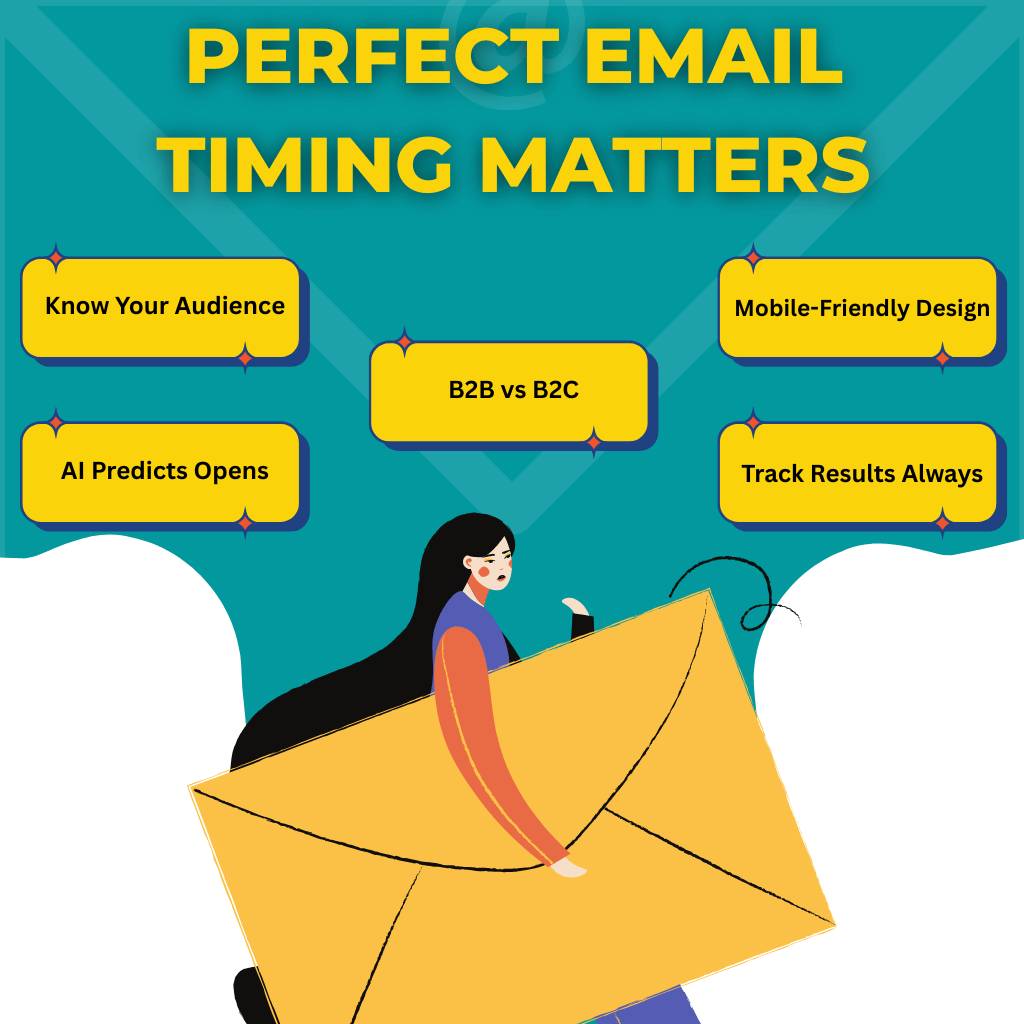
Knowing your audience is vital in affiliate or any digital or physical industries. Emails for businesses (B2B) need different times than those for shoppers (B2C). Industries vary, too. Reaching global customers means sending at their local ideal time.
Finding your perfect moment uses smart tests and AI. AI can predict when each person will open. This increases engagement with a huge product sale 260% ROI.
Besides timing, success also comes from catchy subject lines, mobile-friendly website designs, and always checking results. These points give you about 75% of the big picture for email marketing success.
Today’s digital world is noisy with huge freelance and other business opportunities. Still, your message has to cut through the clutter. Just being there isn’t enough; you need. Mastering this makes your email marketing truly powerful and profitable.
1. When’s the Best Time for My Emails to Sparkle?
Sending emails at the best moment is like showing up at a party when everyone’s ready to chat, not when they’re asleep. You want to grab people’s attention when they’re open to it.
Why email timing is necessary:
Inbox Overload is Real
About 376 billion emails are sent daily. Your email is just one among many. Sending it when fewer emails are flying around, or when your audience is actively checking, helps it get noticed. Learn more in a Statista report on email volume.
Short Attention Spans
People today have very short attention spans. If your email lands when they’re busy, they’ll likely miss it. Good timing means your message gets their brief, but full, attention.
It Helps Delivery
Email providers watch how often your emails get opened. If they’re often ignored, providers might mark them as spam. Sending when people want to open helps your emails land where they should. It builds trust, like a mail carrier who always delivers on time.
It Gets Action
Emails aim for clicks, sales, or sign-ups. If your email arrives when someone is ready to shop, they’re much more likely to act. A well-timed email is like a perfectly thrown dart.
2. What’s the Top Day to Hit “Send”?
Yes, some days are better for emails. It’s like a weekly rhythm. Certain days just get more email engagement. The day choice can make your email stand out like a lone star in a night sky, or vanish.
Is Tuesday still the champ for sending emails?
Yes, Tuesday remains a strong contender for email open rates. It’s like the steady, reliable friend in your contact list. People are typically over the Monday morning rush by then.
They’re settled into their workweek, checking inboxes for useful content. Brevo’s benchmarks show Tuesday maintaining a robust open rate around 21.8%. So, for simply getting your email seen, Tuesday is often a safe bet.
Or has Thursday taken the lead in making more sales?
While Tuesday often sees strong open rates, Thursday is rapidly becoming the powerhouse for conversions and sales. It’s like the grand finale of the week.
Why Thursday? As the week winds down, people’s mindsets shift. For consumer-focused emails (B2C), they might be planning weekend activities or shopping. They’re moving into a “personal time planning” mode. This makes them more open to offers.
Thursday yielded a 33.5% higher revenue per recipient! This means Thursday emails don’t just get opened; they get action. It’s about getting fingers to click that “buy” button.
On any day, should you avoid sending emails?
Yes, like a stormy sea, some days are just bad for sailing.
Weekends (Saturday & Sunday): These are consistently the lowest-performing days for most email campaigns. People are enjoying personal time and are highly unlikely to engage with marketing messages.
Sending then is like trying to give a business presentation at a family picnic – awkward and ignored. Studies often show weekends with the lowest email open rates, sometimes below 17%.
Friday Afternoons: As the week closes, people mentally check out. They’re anticipating the weekend, not reading long emails. Your message will likely sink, unread, into their inbox. The afternoon is generally a no-go zone.
Early Monday Mornings: For general marketing, Monday mornings are often “catch-up” time. Inboxes are flooded with weekend overflow. Your email might get lost. It’s often better to wait until people have cleared their initial Monday clutter.
Why these days fail: It’s about human behavior and work-life balance. People mentally “log off” on weekends and by Friday afternoon. Mondays are often about triage. Ignoring these patterns is like shouting into a strong wind – your message simply won’t carry.
What Time of Day is Best for Email Delivery?
Knowing the best time to send emails is like finding the perfect moment to tell a joke. If you time it right, everyone laughs. If you don’t, it falls flat. With overflowing inboxes, precise timing makes your email stand out like a beacon.
Is there a “magic window” during the day to send emails?
Yes, there usually is a “magic window.” But it’s more like a flexible prime time than a rigid slot. You want to hit their inbox when they’re most likely to engage.
People check emails at specific points:
Morning Catch-up: The First thing when they start their day.
Lunch Break: A quick scroll during downtime.
End of Workday/Evening: Winding down, looking for personal content.
These windows often lead to higher email open rates and clicks.
Morning, afternoon, or evening – which wins for opens and clicks?
Generally, mid-morning still leads for both opens and clicks. But late afternoon/early evening is gaining ground, especially for consumer messages.
Mid-Morning Dominance (9 AM – 11 AM): This window remains a sweet spot. People have arrived at work, handled urgent tasks. Now they check their inbox for other content. This is true for business-to-business (B2B) emails.
Many reports, like AWeber’s insights for 2025, suggest 9:00 AM to 11:00 AM local time is best. People are “catching up on their inbox after starting their workday.” They’re ready to receive.
Afternoon (1 PM – 3 PM): This window can see a secondary boost. People might check emails after lunch. It’s often good for newsletters or deeper reads.
Late Afternoon/Early Evening (4 PM – 6 PM): This time is becoming very strong for consumer-focused (B2C) content. People are winding down, commuting, or relaxing at home. They are more open to sales or entertainment.
4-6 p.m. is a strong window. Wix.com also points to high engagement around these times. This catches people in a more relaxed, Browse state.
The “Why”: These patterns follow daily routines. Morning slots catch people when they’re fresh. Later slots catch them when they’re shifting from work to leisure. Your email campaign strategy should match these shifts.
Does 9-11 AM still work best for most people?
Yes, 9-11 AM is still a strong, reliable window for many. This is especially true for emails about work or general info. It’s a consistently high-performing time for email open rates and initial clicks. It’s your dependable baseline.
Personalization is King: The true “magic window” is unique for each person. If someone always opens your emails at 8 PM, sending at 9 AM might miss them.
This intelligent timing is highly valued. Personalized emails, driven by such insights, can lead to 6x higher transaction rates (SoCal News Group).
Local Time Zones Matter: If your audience is worldwide, sending at 9 AM in New York might be too early in California. Always adjust to the recipient’s local time zone. Many email platforms offer this feature.
Does Your Audience Change the Best Send Time?
Understanding your audience isn’t just a nicety; it’s the bedrock of successful email marketing. Imagine trying to sell snow shovels in the desert – timing doesn’t matter if your audience has no use for them. knowing your customer is more vital than ever for your email campaign strategy.
Do business (B2B) emails need a different timing than consumer (B2C) emails?
Absolutely, yes. B2B and B2C emails are like two different species of birds: they fly at different times and look for different things. Their daily rhythms are distinct, so your best email send time must adapt.
B2B (Business-to-Business): These emails target professionals at work.
Logic: Professionals check emails during work hours. They seek info, solutions, and connections for their business. Mornings and after lunch on weekdays are prime.
Typical Best Times: Tuesday, Wednesday, and Thursday, usually 9 AM to 3 PM local time. They’re settled in and focused.
Statistics: A report from Stripo on B2B email marketing notes 59% of B2B marketers see email as their top revenue channel.
B2B emails might have lower open rates (around 15.14% according to OptinMonster). But their click-through rates (CTR) are often higher at 3.18% vs. B2C’s 2.09%. This means B2B emails, when opened, drive more action.
B2C (Business-to-Consumer): These emails target individuals for personal purchases or leisure.
Logic: Consumers check emails during their downtime. This includes commutes, lunch breaks, evenings, or weekends. They often look for deals, entertainment, or things to make life easier.
Typical Best Times: While mid-week mornings are good, evenings (6 PM – 10 PM) and even weekends can work well. People are more relaxed and open to browsing.
Statistics: Cropink’s email marketing statistics show B2C emails generally have higher open rates (around 19.7%). Email also drives 66% of consumer purchases.
Does the best send time vary for different industries (like shops vs. schools)?
Absolutely. Different industries mean different customer behaviors. So, your email marketing schedule must be unique. It’s like having a universal key that only fits one lock – you need the right key for each door.
Retail & E-commerce:
Logic: Shoppers are active during lunch, evenings, and weekends. They respond well to sales or new product alerts.
Optimal Send Times: Often mid-week (Tuesday-Thursday) late mornings (10-11 AM) for awareness. Also evenings (7-9 PM) and Saturday mornings (10 AM) for sales.
Statistics: Retail emails average around a 33.80% open rate and a 1.11% click rate (OptinMonster, 2025). Abandoned cart emails are very effective, with a 45% open rate and 21% conversion rate (Competitors.app,).
Education (Schools, Online Courses):
Logic: Parents and students check emails at specific times. These often link to school schedules or study times. Deadlines or event info might be best received during the week.
Optimal Send Times: Often early morning (8-10 AM) or late afternoon (3-5 PM) on weekdays. This aligns with school routines.
Statistics: Education emails have a high open rate, around 39.50% (OptinMonster, 2025).
Healthcare & Wellness:
Logic: These emails are often sensitive. People might check them during personal, quiet times.
Optimal Send Times: Can vary, but often early mornings or evenings for appointment reminders or wellness tips.
Statistics: Healthcare emails have high open rates, often over 21% (Competitors.app, 2025). This shows the personal importance of these messages.
What if your customers are all over the world?
If your customers are everywhere, a generic send time is like throwing darts blindfolded. You need a time zone-aware strategy.
Local Time Sending: This is the most crucial step. Your email platform should send emails based on the recipient’s local time zone. So, if your “best” time is 10 AM, someone in London gets it at 10 AM London time. Someone in New York gets it at 10 AM New York time. This ensures your message arrives at their optimal window, no matter where they are.
Audience Segmentation by Geography: Beyond local time, group your audience by region. This allows for truly tailored content. It can include relevant local holidays, events, or even weather. An offer for winter coats won’t work for someone in a summer climate.
How Can You Find Your Perfect Send Time?
Finding your “perfect send time” isn’t a shot in the dark anymore. it’s a science, powered by smart testing and cutting-edge technology. Think of it like a seasoned chef tweaking a recipe: small changes, precise measurements, leading to the perfect dish.
Can you test at different times to see what works for your audience?
Absolutely! This is called A/B testing, or split testing, and it’s your most powerful tool. It’s like having two different alarm clocks and seeing which one wakes you up best. You compare different versions of your email to see which performs better.
How it Works: You send one version of your email at Time A (e.g., 9 AM) to a small part of your audience. You send another version at Time B (e.g., 3 PM) to a different, similar small group. Then, you look at the email open rates, click-through rates, and even sales conversions.
The Logic: Your audience is unique. What works for a general report might not work for your specific customers. A/B testing removes guesswork. It works as a data communication course to use email correctly.
What to Test: Don’t just test times! Also test:
Subject lines: Different wording, emojis, and personalization.
Call-to-action (CTA) buttons: Different colors, text, and placement.
Content: Short vs. long emails, image-heavy vs. text-heavy.
Sender name: From a person vs. a company.
Are there tools that can help you send emails at the best time automatically?
Yes, definitely! Modern email marketing platforms are packed with automation tools that take the heavy lifting out of sending. They’re like having a smart assistant who knows exactly when to send your messages.
Types of Tools: Top platforms like ActiveCampaign, Klaviyo, HubSpot, Brevo, and MailerLite offer powerful automation features.
How They Help:
Scheduled Sends: You set a specific time, and the tool sends it.
Time Zone Sending: The tool sends the email at your chosen time based on each recipient’s local time zone. This is crucial for global audiences.
Automated Workflows: You can set up “if-then” rules. For example, if someone clicks a link, send a follow-up email three days later. This is great for welcome series, abandoned cart reminders, or re-engagement campaigns.
Does AI know when your customers are most likely to open?
Yes, AI also performs as a consultant in finding your perfect send time. It’s like having a super-smart fortune teller for your emails. AI doesn’t guess; it uses data to predict.
How AI Works:
Predictive Sending: AI tools analyze mountains of past data. This includes when individual subscribers opened emails, clicked links, and even made purchases. It learns their unique habits. Then, it predicts the optimal send time for each person, not just for a group.
Subject Line Optimization: AI can even suggest subject lines that are more likely to get opens based on past performance. Some tools claim this can boost open rates by 30%. (Mailtrap).
Content Personalization: Beyond timing, AI helps tailor email content. It recommends products or articles based on past browsing or purchase history.
Statistics:
Almost 90% of marketers expect over three-quarters of their email marketing operations to be AI-supported by the end of 2026 (Litmus, 2025 via Cognism). This shows huge industry confidence.
39.7% of users are interested in AI features for automatic content and image generation in emails (Selzy, 2023 via Cognism).
AI-powered tools are a unique idea for 2025 because they allow hyper-personalization at scale. This was impossible manually before.
What Else Makes an Email Campaign Awesome?
Timing is crucial, like setting the stage for a play. But even with perfect timing, the play itself needs to be brilliant! Your email’s content, look, and ongoing performance checks are just as vital for email marketing success. They make your email truly “awesome.”
Besides timing, what makes people open your emails?
Beyond just when you send, several elements act like magnetic forces. They pull people to open your messages. It’s about building trust and excitement, like a favorite author’s new book release.
Compelling Subject Lines
This is your email’s headline. It’s the first impression. It needs to grab attention instantly.
Logic: In a crowded inbox, a subject line is your only chance to stand out. Make it short, clear, and intriguing. Personalization, emojis, and urgency can boost its power.
Recognizable Sender Name
People open emails from brands or people they know and trust. Your “From” name is your identity.
Logic: If your email comes from a generic address, it feels impersonal. If it’s “Sarah from [Company Name],” it feels more human. Trust builds over time.
Personalization & Relevance
This means tailoring the email content to each individual. It’s like having a conversation, not giving a lecture to a crowd.
Logic: People want emails that matter to them. Using their name is basic. Going deeper means showing products they’ve viewed, offers based on past buys, or content related to their interests.
Does your email look good on phones?
Yes, absolutely! If your email doesn’t look perfect on phones, it’s like opening a wrinkled, hard-to-read letter. Most people will just delete it. Mobile optimization is not optional; it’s a fundamental requirement.
Logic: People check emails everywhere: on their commute, while waiting, at home. Mobile is the dominant way. If your email looks broken, images are too big, or text is tiny, it creates a bad user experience.
Statistics: Over 55% of all email opens happen on mobile devices. Some sources even say up to 81% of Millennials prefer to open emails on their smartphones. Crucially, 50% of recipients delete emails not formatted for mobile within seconds. Companies using mobile-friendly emails see a 15% increase in mobile clicks.
What “Looks Good” Means:
Responsive Design: Your email automatically adjusts to any screen size (phone, tablet, desktop).
Large, Readable Fonts: Easy to see without zooming.
Tap-Friendly Buttons: Big enough for a finger to tap easily.
Optimized Images: They load fast and don’t break the layout.
Clean Layouts: Plenty of white space, easy to scan.
How often should you check if your send times are still working?
You should continuously monitor and test your send times. It’s not a “set it and forget it” task. Think of it like checking your car’s tires: you don’t just set the pressure once; you check it regularly because conditions change.
Why is Continuous Monitoring Essential?
Audience Habits Change: People’s routines shift (e.g., more remote work, holiday seasons).
Competition Evolves: Other businesses might change their send times, impacting your performance.
New Data Emerges: AI and analytics tools get smarter, offering new insights.
Recommended Frequency:
Basic Check: At least monthly for a general overview of your email open rates and click-throughs.
Deep Dive/A/B Test: Conduct dedicated A/B tests on send times quarterly. Or whenever you see a noticeable dip in engagement. This means testing different times or days against your current “best.”
Campaign-Specific: For important campaigns (e.g., product launches, major sales), test specific times relevant to that goal.
What to Look For: Pay attention to not just open rates. Also check click-through rates, conversion rates, and even unsubscribe rates after a specific send time. A high unsubscribe rate might signal you’re hitting them at the wrong moment.
Email marketing continues to be a powerhouse, with a strong ROI of $36 for every $1 spent (HubSpot, Litmus, Omnisend, data). The more “awesome” your campaigns, the higher the return. The global email marketing market size is estimated at $10.84 billion (Research and Markets), showing immense opportunity for specialists.
To excel here, you need a diverse set of skills:
Compelling Writing: Crafting words that captivate and persuade.
Design Sense: Understanding responsive design for mobile. Knowing how visuals impact readability.
Analytical Prowess: Not just reading data, but knowing what questions to ask. Identifying trends and issues.
A/B Testing Mastery: Designing effective tests and interpreting results.
Automation/AI Proficiency: Setting up smart workflows and leveraging AI for deeper personalization and optimization.
Customer Empathy: Truly understanding your audience’s needs and behaviors.
Full-Service Email Campaign Consulting:
Deliver Integrated Solutions: Don’t just offer timing advice. Provide complete email campaign strategy packages. Include content, design, list segmentation, and automation.
Focus on User Experience: Prioritize how the email feels to the recipient, especially on mobile. A smooth experience builds loyalty.
Show “Before & After”: Demonstrate the tangible improvements your holistic strategies bring. Use clear metrics (e.g., “Your mobile open rate increased by X%”).
Emphasize Long-Term Value: Explain that email marketing builds lasting relationships, not just quick sales. Consistent optimization ensures sustained email marketing success.
Stay Relevant with Trends: Keep learning about new design trends, privacy changes, and AI advancements. Your expertise needs to be cutting-edge.
Conclusion
Thus, your emails are seeds. Timing is sunshine. Subject lines are rain. Together, they grow trust. Send like a gentle knock. Test, learn, and flow. Be the clear bell in the noise. Shine bright. The best is coming.
FAQ
How often should I send an email campaign?
Send 2–3 emails per week (8–12 a month). Newsletters work best at 1 email weekly. E-commerce? 2–4 emails per month. One email a month can hit a 28% open rate. Track clicks, opens, and unsubscribes. If unsubscribes go above 0.2%, slow down. Test often. Segment your list. Active users = more emails. Quiet users = fewer.
What is a good opening rate for an email campaign?
A good open rate for email campaigns is around 42 %. That’s the typical average across industries.
If you’re sending newsletters, aim higher: 50 % open rate puts you in the top half. 60 %+ is top-tier.
For general marketing emails, hitting 30 %+ is solid. 45–50 % is strong. 50 %+ is exceptional.
So:
≈ 42 % = average
30 %+ = good
45–50 % = strong
50 %+ = excellent
Test subject lines and timing. Track your trend. Aim to beat the 42 % average.
What is a bad email open rate?
A bad email open rate is under 20%.
The global average is 42%.
15% or less is very poor.
10% or less is critical.
It shows weak subjects or bad timing.
Which type of email has the highest open rate?
Welcome emails win with a 70% open rate.
Transactional hit 50–60%.
Newsletters get 40–45%.
Promos are only 20–30%.
Always send a welcome email first. It works best.
What’s the most professional email to use?
Use your domain email (name@company.com).
Avoid free emails.
86% trust branded emails more.
Keep it short and clear.
No numbers or slang.
Custom emails boost opens by 20%.
What is the most appropriate email opening?
Use “Hi [Name],” or “Hello [Name],”.
Avoid formal greetings like “Dear Sir/Madam.”
Personal openings get 30% more replies.
Keep it short and polite.

Aliza Khatun is a Digital Marketing Professional and the founder of DigiGenHub. She has helped various businesses grow their online presence through real-world experience in marketing, branding, traffic growth, and business strategy.
Through DigiGenHub, she shows how to build and grow a business from the ground up using Website Setup, SEO, Branding, Paid Promotion, and smart digital tools.
She also highlights how AI can be used to its full potential to make content creation, automation, marketing, and business growth faster and smarter.
She believes that the right knowledge, modern technology, and the right tools can help any individual or business build a stronger online presence.