
SEO strategy services are in dire need for any business that aspires to dominate the digital space. So, industries like e-commerce, local businesses, tech startups and online education are betting big on it.
Still, if you’re a flawless SEO expert, your earnings possibilities are significant. Starting at $25-$50/hour, you can easily earn $3,000-$6,000/month.
With more experience, you could raise that to $50-$150/hour, bringing in $5,000-$15,000/month.
At senior levels, you can charge $150-$500/hour, earning upwards of $10,000-$50,000/month.
The astounding happens when you scale from solo work to running your own agency.
With profit margins of 20-30%, you could turn $500,000/year into $100,000-$150,000 in profit.
Tools like SEMrush, Ahrefs and Google Analytics will be your best friends in fine-tuning your strategies.
Again, getting certified by Google, HubSpot, or Moz will instantly spread your reputation.
Market Demand for SEO Strategy Services
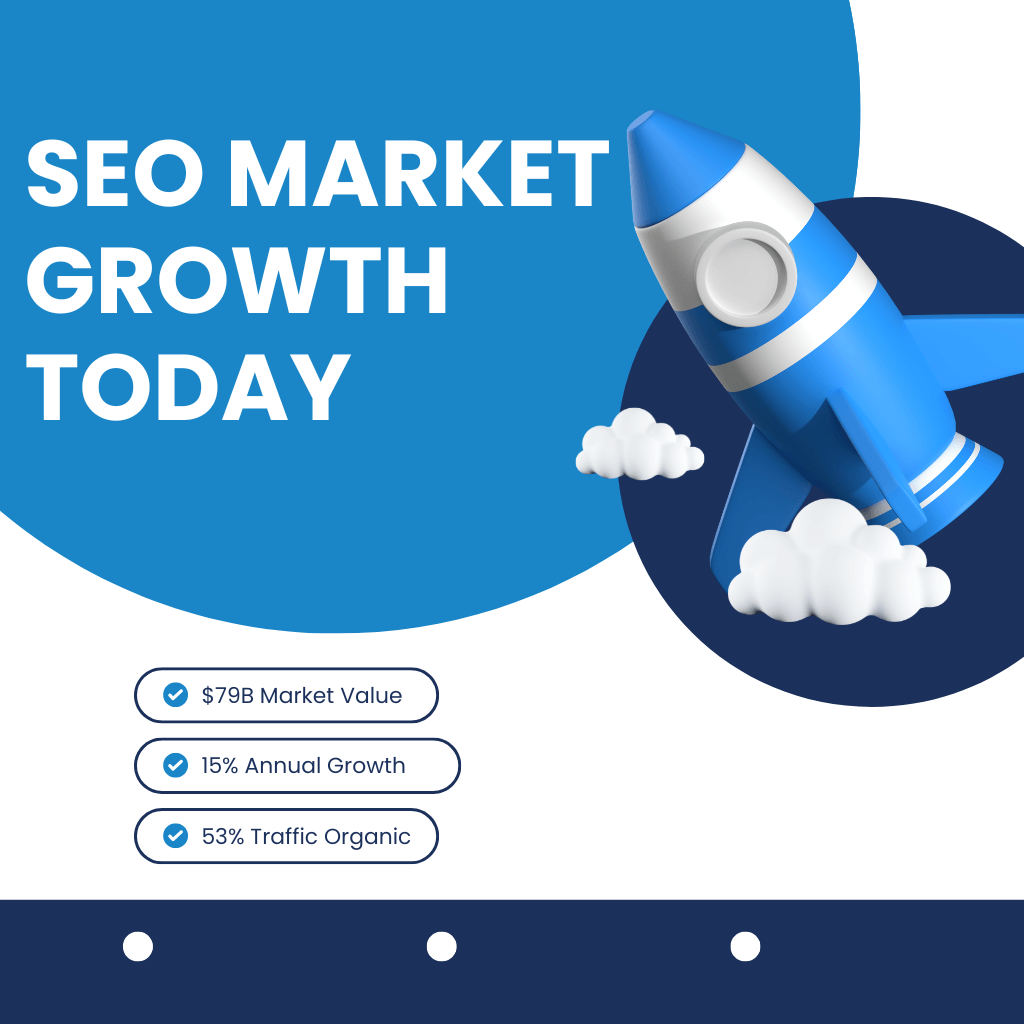
The SEO market is huge. It was worth $79 billion in 2023. It’s growing at 15% per year and is expected to reach even higher numbers by 2027. (Forbes)
Organic search drives over 53% of all website traffic. This is more than ads. SEO keeps growing as businesses see its value. ( BrightEdge)
Most of the industries are investing in SEO. A few of them are:
E-commerce: Online stores need SEO to stand out. Amazon and Shopify spend millions on SEO.
Example: Amazon invests over $1 billion annually in SEO. ( Forbes)
Local Businesses: Restaurants and clinics use local SEO to reach customers nearby. 76% of “near me” searches lead to a visit within one day. ( Think with Google)
Tech Startups: Small tech companies focus on SEO to get traffic without spending too much.
Example: Gusto used SEO to grow their leads by 80% without ads.
Online Education: SEO helps e-learning platforms rank higher for courses.
Example: Coursera grew its traffic by 45% using SEO. (Coursera)
How to Map Package and Offer SEO Strategy Services
To offer SEO strategy services effectively, you must calculate the right package based on your client’s needs. Let’s explore the different service options:
SEO Strategy Service Packages Plan
| Service Type | Time Required | Service Fee | Target Audience |
| Basic Package | 3-5 hours/month | $500 – $2,500/month | Small businesses |
| Custom Package | 20-50 hours/month | $5,000 – $15,000/month | Medium to large businesses |
| Long-Term Strategy | Ongoing | $2,500 – $10,000/month | Established brands |
Essential Service Components
1. Site Audits
The audit is the starting point. It’s like a doctor diagnosing a patient. The audit checks for issues that could harm a website’s SEO, like slow loading times or broken links.
2. Keyword Research
Keyword research uncovers what potential customers are searching for. Use tools to find these keywords and create content around them.
Long-tail keywords are more relevant and have a higher conversion rate. For example, Gusto used SEO and keyword research to capture 80% more leads. ( Gusto)
3. Content Planning
High-quality, helpful content keeps visitors engaged and ranks well on Google.
Content strategy is central to SEO. Buffer ranks high by consistently producing content that adds value to its users. (Buffer)
4. Technical SEO
This ensures the website is technically optimized. It includes fixing broken links, improving site speed and ensuring mobile-friendliness.
Sites that perform better technically rank higher. Websites with fast load speeds see a 20% increase in sales. (Shopify)
5. Local SEO Services
Local businesses target specific locations. Local SEO Services create huge opportunities for the experts.
76% of “near me” searches lead to a store visit within one day. Local SEO drives foot traffic. (Think with Google)
How to Price SEO Strategy Services ( Obtain Maximum Profit and Client Satisfaction)
Setting the right price for SEO services is critical for building a sustainable, profitable business. Pricing should reflect the value you bring to clients while remaining competitive. Let’s learn how to do it effectively:
A . Common Pricing Models
1. Hourly Rate
Charging by the hour is one of the simplest methods. It’s useful for small tasks like audits or one-time fixes.
For entry-level SEO experts, rates range from $25 to $50/hour. Experts can charge $100 to $250/hour or more, depending on experience and reputation.
2. Retainer
A retainer is a monthly fixed fee for ongoing services. This is ideal for businesses that need consistent SEO support over time.
Retainers generally range from $500 to $5,000/month. Large businesses may pay $10,000 to $50,000/month for comprehensive services.
3. Project-Based Pricing
This model works well for specific projects, like a website overhaul or a one-time SEO audit.
4. Performance-Based Pricing
Performance-based pricing involves earning based on the results you deliver, such as increasing traffic or improving rankings.
This varies widely. Some SEO experts charge a percentage of the increase in sales or traffic. A common model might involve a 10% to 20% share of the revenue increase after achieving set KPIs.
B . Benchmarking Rates
SEO pricing varies based on a few points. These are experience, location and the complexity of the services offered.
Entry-Level SEO Experts
Hourly Rate: $25 – $50/hour
Monthly Retainer: $500 – $2,500/month
Project-Based Fee: $1,000 – $5,000/project
Client Type: Small businesses, local companies
Mid-Level SEO Experts
Hourly Rate: $50 – $150/hour
Monthly Retainer: $2,500 – $7,500/month
Project-Based Fee: $5,000 – $15,000/project
Client Type: Medium-sized businesses, startups
Expert-Level SEO Consultants
Hourly Rate: $150 – $500/hour
Monthly Retainer: $10,000 – $50,000/month
Project-Based Fee: $15,000 – $50,000/project
Client Type: Large corporations, high-budget companies, global brands
Packaging Services to Increase Value and Justify Premium Pricing
1. Create Comprehensive Packages
Instead of offering just one service, bundle related services into packages. For example:
Basic Package: Site audit, keyword research, basic on-page SEO.
Premium Package: Includes everything in the basic package, plus content strategy, backlink building and monthly reporting.
2. Show ROI Through Metrics
Clients are more willing to pay premium prices when they can see the direct impact on their business.
3. Offer Ongoing SEO Services
Create long-term packages for clients to ensure continuous improvement. Include regular content updates, monthly reports and quarterly strategy adjustments.
5. What Are the Most Lucrative Ways to Earn from SEO Consulting?
SEO consulting has many ways to make money. It’s not just about doing SEO work once. You must offer steady income options, upsell services and find ways to make passive income.
1. Retainers vs One-Off Projects — Which is Better for Steady Income?
Retainers are a great way to earn a stable income. Clients pay you monthly for ongoing SEO services, like audits, content updates and fixes.
Pricing: Retainers usually range from $500 to $10,000 per month.
2 . One-off Projects are good for short-term work, like audits or specific tasks.
Pricing: A one-time project can cost between $1,000 to $20,000.
2. Upselling and Cross-Selling SEO-Related Services
Upselling means offering more services to existing clients. For example, if you’re already doing SEO, offer PPC (Pay-Per-Click) or content marketing as add-ons.
Pricing: You can charge an additional $500 to $5,000/month for PPC or content services.
Cross-selling means offering complementary services like analytics to track performance.
Why It’s Lucrative:
Higher Client Spend: Offering more services means you make more money.
Ongoing Work: Clients need continuous help, which means more steady work for you.
3. Passive Income Options: SEO Courses, Templates and Consulting Calls
Create products that make money without much work.
SEO Courses: Create and sell SEO courses. Once they’re made, they can earn money over time.
Earnings: Good courses can make $1,000 to $50,000/year.
SEO Templates: Sell templates for audits or content strategies.
Consulting Calls: Charge for 1:1 calls where you advise clients on SEO.
Why It’s Lucrative:
Scalable: Once created, courses and templates can be sold to many people.
Low Maintenance: After the initial work, you keep earning passively.
Example: Brian Dean earns through his SEO courses and guides. His passive income grows steadily from these products. (Backlinko)
What Is the Step-by-Step Process to Deliver Winning SEO Strategies
Follow these steps to offer top-notch SEO strategies to build a solid career:
1. Initial Audit & Diagnostics: Check the Health
Start by auditing the website. It’s like a health checkup for the site. This step finds problems like slow load speeds, broken links and weak content.
Catching issues early saves time and achieves hopeful results. For example, a good SEO audit helped Vistaprint increase traffic by 200% in 6 months. (Moz)
2. Strategy Consistant with Business Goals: Build the Plan
Once the audit is done, create a strategy. This strategy should fit your client’s goals—whether it’s to increase sales, grow local visibility, or build brand authority.
SEO now needs to be more personalized. Use long-tail keywords that fit the audience’s needs and search behavior. HubSpot grew its organic leads by using this approach. (HubSpot)
3. Execution Roadmap: Content, Links and Fixes
Now it’s time to put the plan into action. This step includes creating quality content, building strong backlinks and fixing technical issues on the website.
Content: Focus on content that solves real problems. Buffer built its authority with helpful social media guides. (Buffer)
Link-Building: Quality backlinks are a must. Build links through guest posts, collaborations and relevant content partnerships.
Technical Fixes: Google values speed and mobile optimization more than ever. A slow website can lose 40% of visitors.For example, a Shopify merchant boosted sales by 20% after improving their site speed. (Shopify)
4. Monitoring, Reporting and Iterative Optimization: Keep Improving
The online world changes fast. What worked yesterday might not work today. So, SEO is never a one-time job. Always monitor performance, check analytics and optimize based on data.
Yet, you must be aware of the following objects:
1 . User Experience: A website should be fast, responsive and easy to use. If visitors are frustrated, they’ll leave. Good UX will boost rankings.
2 . AI & Automation: Use AI tools to speed up keyword research, data analysis and reporting. These tools can save time and improve your results.
3 . Mobile Optimization: More than 50% of all web traffic comes from mobile. Google ranks mobile versions first, so make sure your site is mobile-friendly. ( Statista)
4 . Core Web Vitals: Google now focuses on the Core Web Vitals—page speed, interactivity and visual stability. If these aren’t good, your rankings will drop.
5 . Evolving Algorithms: Google updates its algorithm all the time. Keep learning and stay updated with the latest changes. RankBrain is one of Google’s key algorithms to understand user intent.
How to Build a Personal Brand as an SEO Expert to Attract Better Clients
A strong brand helps you stand out and shows that you know SEO inside and out. Let’s learn how to build it.
1. Present Case Studies and Results
Share real examples of how you’ve helped other businesses. A case study is proof that you can deliver. Clients want to see real results. Numbers speak louder than words.
What to include: Share specific numbers, like “increased traffic by 50% in 6 months.”
Example: Ahrefs often shares case studies on their blog, showing how their tools help businesses rank higher. (Ahrefs)
2. Network, Speak and Publish SEO Insights
Network: Attend SEO events and webinars. Meet industry leaders.
Speak: Offer to speak at events or webinars. Speaking boosts your credibility.
Publish: Share your knowledge on LinkedIn or your blog. Regular posts make you stand out.
Yet, networking, speaking and sharing insights keep you visible. They also build your authority as an SEO expert.
Example: Rand Fishkin, founder of Moz, built his brand by speaking at events and sharing his thoughts on SEO. (SparkToro)
3. Expand Social Media and SEO Communities
Use social media and SEO communities to show your knowledge. Active participation in these spaces builds authority and trust. Answering questions shows your expertise.
Social Media: Share tips, results and insights on platforms like LinkedIn and Twitter.
SEO Communities: Join Reddit SEO, Quora, or SEO forums. Answer questions and join discussions.
Example: Gary Vaynerchuk built his brand by sharing advice online and interacting with followers. This made him an authority across many fields, including SEO. ( Gary Vaynerchuk)
What are the Small Business SEO Tools for Client Success
The right SEO tools save time, increase precision and improve results. Let’s explain the must-have SEO tools and technologies for SEO experts:
1. Must-Have SEO Software for Strategy, Auditing and Tracking
1.1 Site Auditing: Screaming Frog and Sitebulb
Screaming Frog and Sitebulb are essential for checking your site’s health. They find issues like slow speeds, broken links and missing data. Fixing these problems helps websites rank better.
Example: Screaming Frog can crawl up to 500 pages for free. It’s fast and easy to use. (Screaming Frog)
1.2 Keyword Research: SEMrush and Ahrefs
SEMrush and Ahrefs help you find the best keywords to target. They show what’s working for your competitors.
Example: Ahrefs has a database of 12 trillion links and provides powerful keyword data. (Ahrefs)
1.3 Analytics: Google Analytics and Google Search Console
Google Analytics tracks your website’s traffic, while Google Search Console tells you how your site is performing in search results. These tools help you see what’s working and what needs improvement.
Example: Google Analytics shows you traffic, bounce rates and conversions. (Google Analytics)
2. Automation and AI-Powered Tools to Save Time and Boost Precision
2.1 AI Content Creation: Jasper and Copy.ai
Jasper and Copy.ai are tools that use AI to create content fast. They help you write blog posts, ads and social media content. These tools save time and help create SEO-friendly content quickly.
Example: Jasper is used by SEO agencies to create high-quality content at scale. (Jasper)
2.2 Automating Reports: Google Data Studio and Supermetrics
Google Data Studio helps you create reports from data, while Supermetrics pulls data from multiple sources into one place. Automation saves time and provides clients with regular, updated reports.
Example: Google Data Studio creates customized, easy-to-read reports from Google Analytics and Search Console. (Google Data Studio)
2.3 Backlink Analysis: LinkMiner and Ubersuggest
LinkMiner and Ubersuggest help you find high-quality backlinks. They show you where competitors are getting links and suggest where you can get yours.
Why it matters: Backlinks are important for ranking. These tools help you build a strong link profile.
Example: Ubersuggest provides a detailed overview of competitors’ backlinks. (Ubersuggest)
The SEO software market is growing fast, projected to reach $3 billion by 2025. (Forbes)
What Are the Realistic Earnings and Career Growth Milestones?
SEO offers many ways to earn and grow. Let’s learn:
1. Entry-Level Earnings
Hourly Rate:
Entry-level SEO professionals charge $25 to $50 per hour.
Monthly Earnings: This can add up to $3,000 to $6,000 per month.
A beginner freelancer on Upwork can earn around $3,000 per month after getting a few clients. (Upwork)
2. Mid-Level Earnings
Hourly Rate:
With experience, you can charge $50 to $150 per hour.
Monthly Earnings: This could range from $5,000 to $15,000 per month.
Example:
A mid-level SEO consultant with 5+ years can earn around $8,000 per month, working with bigger clients. (Forbes)
3. Senior-Level Earnings
Hourly Rate:
Experienced SEO experts charge $150 to $500 per hour.
Monthly Earnings: You can earn $10,000 to $50,000 per month.
4. Scaling from Freelancer to Agency Owner
Freelancers can scale their business by becoming agency owners. This step requires investment and planning.
Starting Costs:
It costs around $5,000 to $20,000 to start an SEO agency. This covers things like branding, tools and hiring a team.
Profit Margins: An SEO agency typically makes 20-30% profit in the early years.
5. Geographic and Niche Factors Impacting Rates
Geographic Impact:
US, UK, Canada: SEO experts charge higher rates, usually 30-40% more than those in countries with lower costs of living.
Developing Countries: SEO consultants in regions like India may charge $10 to $25 per hour, but they can still earn well due to lower living costs.
Niche Impact:
E-commerce SEO: This niche is highly profitable. Businesses in e-commerce are willing to spend a lot to drive more sales through SEO.
Local SEO: Though it’s in high demand, local SEO doesn’t earn as much as global SEO. But small businesses often need this service.
How to Keep Your SEO Strategy Services Strong and Impactful for Vigorous Results
The SEO world changes fast. So, keeping up is imperative to building a successful career.
1. Continuous Learning Map: AI, Voice Search, Visual SEO, Data Analytics
AI in SEO
AI tools help with keyword research, content creation and website optimization. Tools like Jasper and Surfer SEO make SEO faster and more accurate.
AI speeds up SEO tasks and makes your work more efficient. Example: Surfer SEO uses AI to audit and optimize websites, saving time. (Surfer SEO)
Voice Search Optimization
Voice searches are more conversational. Optimizing for voice means using natural language and long-tail keywords. 50% of searches are now voice-based.
Example: Backlinko improved rankings by optimizing for voice search.
Visual SEO
Images and videos matter for SEO. Optimizing them with alt text and making sure they load fast is crucial.
Example: Websites using optimized videos, like Wistia, see better engagement. (Wistia)
Data Analytics
You need data to make smart decisions. Analytics tools help track your SEO efforts. Google Analytics and SEMrush let you see what’s working and what needs fixing.
2. Certifications and Recognized Credentials Boosting Credibility
Certifications build trust with clients. They know you have the skills to deliver. Example: Moz’s certification is highly respected. Certified experts can charge up to 30% more.
3. Experimentation and Innovation to Maintain Competitive Edge
SEO is about trying new things. Test different strategies and tools. What works for one client might not work for another.
Example: A major e-commerce brand saw 35% more traffic by testing new SEO tools.
So, How to Innovate:
A . Use New Tools: Embrace AI, voice search and data tools to work smarter.
B . Get Certified: Certifications show expertise and build trust.
C . Experiment: Test new ideas and stay flexible.
D . Build a Network: Join online SEO communities like Reddit SEO and SEO forums. Networking helps you stay updated.
Conclusion
SEO is an industry that’s evolving fast. So, with the right mindset, tools and constant learning, you can build a name for yourself and become a trusted expert in the field.
FAQ
What businesses benefit most from SEO?
Medical Services: Clinics and virtual care providers see a 90% rise in digital traffic. (globalmediainsight.com)
E-commerce & SaaS: Online stores and software platforms grant SEO services for global reach. Perplexity AI saw a 71% traffic boost. (wordstream.com)
Legal Services: SEO increases law firms local and national visibility, attracting more clients.
Home Services & Food Delivery: Local SEO helps businesses like plumbing and food delivery connect with nearby customers.
Education & Training: SEO helps educational institutions and online courses get more students.
What percentage of businesses use SEO?
This is the list:
SEO Usage Across Various Industries
| Businesses | SEO Usage Percentage |
| Education & Training | 85% |
| Retail (Online Stores) | 85% |
| Travel & Hospitality | 80% |
| Real Estate | 78% |
| Finance & Banking | 70% |
| Health & Fitness | 88% |
| Medical Services | 90% |
| E-commerce & SaaS | 71% |
| Legal Services | 80% |
| Home Services & Food Delivery | 75% |

Aliza Khatun is a Digital Marketing Professional and the founder of DigiGenHub. She has helped various businesses grow their online presence through real-world experience in marketing, branding, traffic growth, and business strategy.
Through DigiGenHub, she shows how to build and grow a business from the ground up using Website Setup, SEO, Branding, Paid Promotion, and smart digital tools.
She also highlights how AI can be used to its full potential to make content creation, automation, marketing, and business growth faster and smarter.
She believes that the right knowledge, modern technology, and the right tools can help any individual or business build a stronger online presence.