
Podcast production for brands is a great way to connect with your audience. It has become a must-do, a functional tool to enrich brand visibility. Over 130 million Americans tune into podcasts every month. That’s more than double from the previous years.
Recently, the podcast industry is worth $5.03 billion and brands that stay consistent see the highest returns (Forbes). Do the math: bright future for your business. Podcast production for brands. (eMarketer)
Still, you must possess some vital qualities to obtain a fruitful outcome. You’ve got to be strategic. Stay consistent. Know your audience inside and out. Without these steps, you’ll lose their attention fast.
If you’re still using basic tools, stop. AI Tools like Descript and Cleanvoice make podcast production effortless. These tools clean up your audio and save you precious time. Without them, you’ll be stuck editing for hours and your content quality could take a hit. That can seriously hurt your brand.
I’ve shared this exact approach with clients, helping them avoid mistakes and scale faster. And trust me, it works. (WARC)
How Does Podcast Production for Brands Unify Your Business Identity?
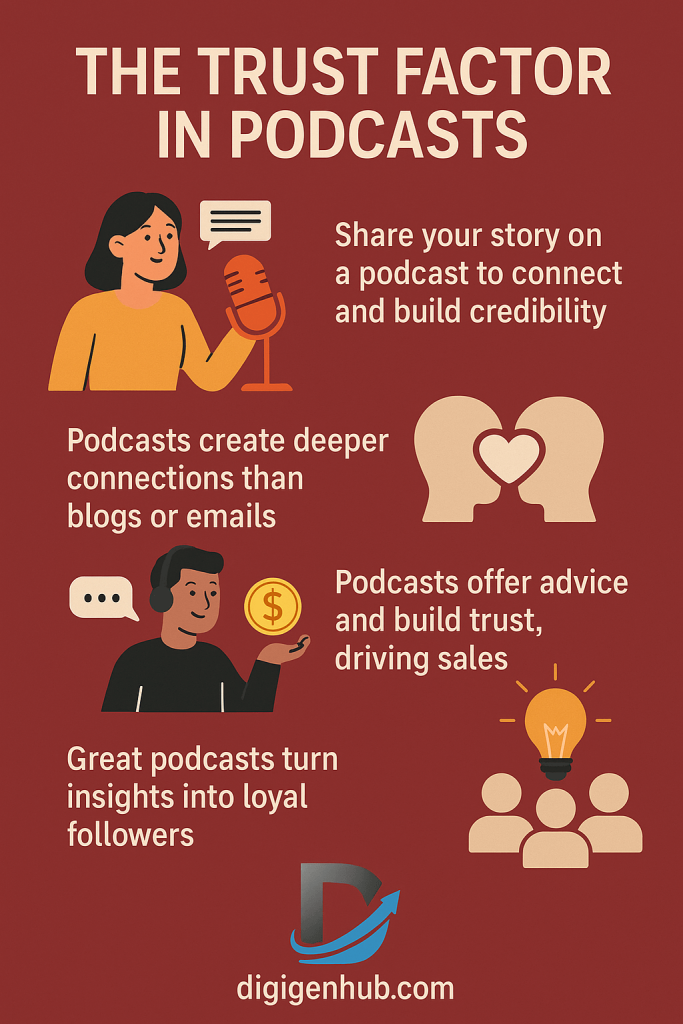
The corporate podcast helps you connect, build trust and share your business story in a personal way.
It lets you share your expertise and build credibility. Indeed, it’s more personal than emails or blog posts. People trust voices they hear regularly. That trust leads to loyalty and sales.
Examples of Successful Podcasts
1. “Aspire With Emma Grede”
Launched in May 2025. Hosted by Emma Grede, co-founder of Good American and Skims. Features top entrepreneurs like Gwyneth Paltrow and Jay Shetty. Learn real, actionable advice. Available on major platforms and YouTube.
2. “Confessions of a Female Founder”
Hosted by Meghan Markle. Talks with female entrepreneurs. Shares challenges and wins. Includes Meghan’s own journey with As Ever.
3. “The Diary of a CEO”
Hosted by Steven Bartlett. Features big names like Richard Branson and Maisie Williams. Over 1 billion streams and 50 million listeners a month.
A podcast helps you connect, share your expertise and build your business. Look at podcasts like “Aspire With Emma Grede” for inspiration.
How to Make a Corporate Podcast to Start a Business Online?
Got a business idea? Start a corporate podcast. First, choose a niche that speaks to your audience, something they actually care about.
Share real stories, sprinkle in value and offer insights that solve problems. Most importantly, stay consistent—people tune in when they know you’re reliable. Let’s justify the following questions to learn more:
How Do You Plan and Structure Your Podcast?
Planning makes everything easy and conventional. Without a plan, your podcast will lack direction. So, start by defining your purpose. What do you want to share?
Structure your episodes with value-packed content. Keep them brief and to the point. Be consistent in releasing episodes.
Who’s Your Podcast Really For?
Know your audience. Who are they? What do they need? Organize your content to their interests and challenges. When you speak directly to their needs, they’ll keep coming back.
What’s the Right Format for Your Podcast?
Choose a format that suits your brand. You can interview guests, tell stories, or share your own thoughts. Microcasts, under 10 minutes, are trending. But if longer episodes fit your brand, go for it. The format is up to you.
How Do You Get the Word Out and Grow Your Business?
Promote your podcast. Use social media to share episodes and engage with your audience. Let your email subscribers know about new episodes.
Submit your podcast to directories like Apple Podcasts and Spotify. Collaborate with other podcasters to widen your reach. More exposure means more listeners.
How to Start a Thriving Podcast that Grows Your Brand?
You need proficiencies: storytelling, audio production, marketing and analyzing data. Learn how to create great content, record quality audio and promote your podcast. Use listener data to improve.
Steps to Start Your Podcast
Know Your Goal
Decide what you want to achieve. Focus on your audience’s needs.
Create a Plan
Pick topics and the type of episodes. Stay consistent with your message.
Get the Right Tools
Use a good microphone and editing software for clear sound. Popular mics include the Shure SM7 B and Audio-Technica AT2020. For editing, use tools like Adobe Audition or Audacity. If you need help, grant a podcast production company.
Promote Your Podcast
Share on social media to strengthen product presentation. Work with guests to expand your reach.
Track and Improve
Use analytics. Adjust your content based on listener feedback.
Still, how to start a thriving podcast that grows your brand? Listen. Starting a podcast is like planting a tree. You start small, but with the right care, it grows into something that gives back. Let’s explain a few questions for nurturing your podcast for branding:
Why Does Consistency Matter for Your Podcast?
Consistency is the sunlight your podcast needs to grow. Without it, your audience will wilt. Just like watering a plant regularly, releasing episodes on time makes your listeners come back.
Build a Content Strategy That Helps Your Brand Grow
A content strategy is your roots. It anchors your podcast and gives it direction. Think of it like planning a garden.
You need to know what your audience craves. Provide episodes that bloom with value and relevance. Indeed, 8 out of 10 marketers use data to guide their content strategy. This proves they’re planting the right seeds for growth (SingleGrain).
Take Your Podcast Up a Notch with Interviews, Stories and Guests
Interviews and stories are like rain. It refreshes, enriches and brings new life to your podcast. Just like diverse crops in a field, having different voices keeps the audience interested.
Guests bring their followers, broadening your reach. When HubSpot brings on an expert, they’re not just growing their knowledge; they’re growing their audience too (Forbes).
Market Your Podcast to Get Noticed
Marketing is the wind that carries your podcast far. Without it, your voice is stuck in the same place. Share your episodes like seeds in the wind across social media, email lists and podcast directories.
Use AI to personalize marketing, which works as fertilizer. It helps your podcast reach more listeners, faster (SingleGrain).
Make Money from Your Podcast in the Long Run
Monetization is the fruit your podcast bears. It’s the reward for all your hard work. Think of sponsorships, listener donations, or premium content as your harvest.
Still, podcast creators are diversifying their income, with many seeing a 30% increase in revenue year-over-year (Forbes).
How Do Google Podcasts Connect Business with Their Audience?
Google Podcasts is your business’s direct link to a global audience. It uses Google’s massive reach to make sure people find your podcast anywhere.
Whether they’re on Google Search, Assistant, or YouTube, your content is always within reach. It’s like having a backstage pass to millions of listeners.
Imagine Google Podcasts as your brand’s personal concierge. It guides listeners straight to your content, no matter where they are.
Whether they’re on their commute, at the gym, or chilling at home, Google Podcasts is there, ready to serve. This platform is like the VIP pass to a packed stadium of podcast lovers. How? Let’s explain:
Accelerate Your Business Progress with Google Podcasts
Google Podcasts is a gateway to a global audience. It places your content in front of millions. This secures Google’s massive reach.
With its built-in SEO powers, your podcast becomes discoverable by anyone who types in a related search term. It’s like setting up a pop-up shop on the busiest street in the digital world. People can’t miss you.
Plus, it integrates across multiple platforms like Google Search, Assistant and YouTube. That means your podcast isn’t just on one app. It’s everywhere, like a well-placed ad across all the right channels.
Google Podcasts gives you access to over 584 million listeners in 2025. It’s more than just a podcast player; it’s a visibility booster. Thanks to Google’s search power, your podcast shows up when people search for related topics. It’s like setting up your shop in the busiest digital street.
For example, Google’s AI-focused podcast reached tech enthusiasts globally. It thrives with millions of listens.
Optimize Your Podcast for Google Podcasts
Normally, you build a business website, maintaining SEO requirements, right? The same goes for podcasts. Use clear, punchy titles, informative descriptions and well-thought-out tags. These little details help your show stand out in the sea of content.
Think of it as planting seeds. Each episode, optimized right, grows your presence. You’ll see more listeners coming back for more, just like returning customers.
Google Podcasts Powers Up Engagement with Analytics
Google Podcasts offers powerful analytics. It shows where your listeners drop off and which episodes you have created that they love. These insights help you tweak your content for better engagement. For example, “The Diary of a CEO” used this data to tailor content, growing to 1 billion streams.
AI-Driven Podcasting for Brands
Imagine having a personal assistant who works nonstop. Yes. AI is available for your brand’s podcast. AI helps you write scripts, edit audio and add effects quickly and easily.
It helps you make great podcasts faster. You can customize the tone and style. Want formal? Casual? AI adjusts to your brand’s voice.
And get this, AI can do it in over 50 languages, including English, Spanish, Chinese, French, Arabic and Portuguese. This makes it easy to connect with global audiences.
You can turn boring text into exciting audio in seconds. Google’s Audio Overviews feature does exactly this. It gives you summaries of your documents as a podcast.
No more struggling with long, complicated text. You can create engaging content that speaks to your listeners. To learn more, check out Google’s Blog and The Verge.
What makes Google’s NotebookLM useful for brands?
Google’s NotebookLM turns documents into podcasts. Upload a report. The AI makes it a podcast. Simple, right? Brands save time and connect better with audiences.
Spotify used this feature for their 2024 Wrapped campaign. They turned personalized data into AI-generated podcasts. It increased engagement and buzz. (source).
How is AI Breaking Language Barriers Worldwide?
AI is translating podcasts into multiple languages. This opens up global markets. Brands can now reach listeners in any country. The world is their audience.
Success Story: Spotify’s CEO, Daniel Ek, plans to make all podcasts translatable into English. No more missed opportunities.
AI Podcasting’s Explosive Growth: Numbers Don’t Lie
The AI podcasting market is growing fast. It has recently jumped from $3.07 billion to $4.06 billion. That’s a 32.2% growth. Brands are tapping into AI to create content faster, cheaper and better.
Market Insight: The global AI podcast market is on the rise. Brands are eager to leverage this tech.
AI Tools for Podcast
Tools like Descript and Adobe Podcast make editing a breeze. Descript removes filler words and background noise in seconds.
Adobe Podcast clears up muffled audio, making it sound like studio quality. Transcription tools like Otter AI and PageOn.ai convert audio into text instantly.
PageOn supports over 90 languages, so you can reach a global audience. Want to promote your podcast? Joyspace automates captioning and creates engaging show notes with emojis and branded templates.
Plus, platforms like Podcastle and Alitu help with marketing and show notes. Alitu cleans up audio and generates transcripts automatically.
Still, AI tools speed up content creation, improve audio quality and make podcasting accessible even to beginners. Let’s learn more in detail:
Integral AI Tools for Podcasting:
Cleanvoice AI
What It Does: Cleanvoice AI helps remove filler words (“um,” “ah”), stuttering and unwanted sounds from podcast audio. It’s like a digital sound engineer.
Why It’s Unique: It automatically cleans up your audio, making it sound professional without needing expert editing skills.
Auphonic
What It Does: Auphonic focuses on audio leveling and quality enhancement. It ensures consistent sound quality by balancing volume, removing noise and improving clarity.
Why It’s Unique: It’s a one-click solution for audio mastering. This tool is perfect for beginners who don’t want to get bogged down in complex editing.
How AI Assists You in Audio Editing, Transcription and Promotion
1. Audio Editing: AI tools like Descript and Cleanvoice AI can automatically remove unwanted elements in recordings. A polished podcast in minutes, not hours.
2. Transcription: AI-powered transcription services, such as Otter.ai and Sonix, instantly convert spoken words into text. This is essential for accessibility, content indexing and SEO.
Why It’s Important: Transcriptions make your content searchable, accessible to hearing-impaired audiences and usable for content repurposing (like blog posts or social media).
3. Promotion: AI tools like Podbean and Headliner are designed to help podcasters create short, shareable clips from their episodes. These clips are ideal for promotion on social media.
What Expertise Do You Need to Enter the AI Podcasting Industry
Want to get in? To enter the AI-driven podcasting world, you need to focus on these core skills:
Vital Talents for AI Podcasting
Content Strategy: You should know how to create engaging and relevant content for your audience. So, craft stories that connect.
Technical Proficiency: Familiarity with AI tools like NotebookLM, Descript, Otter.ai and Sonix will help you automate tasks and optimize production.
Audio Mastery: Understanding audio quality and mastering tools (like Auphonic) is essential for producing professional-grade podcasts. Edit and design sound well.
Marketing: Utilize AI-driven promotion and SEO to grow your audience.
Multilingual Skills: Speak multiple languages to reach global audiences.
Data Analysis: Use feedback to improve.
Basic Perception for Business in AI Podcasting
When starting a podcasting business with AI, prioritize the following objectives:
Accuracy: Always fact-check AI content.
User Experience: Make your podcast easy to use.
Stay Updated: AI evolves quickly. Keep learning.
Ensure Ethical AI Use: Avoid AI misuse, such as generating misleading content. Use AI responsibly. Avoid manipulation.
Data Privacy: Be transparent with listeners about data usage and privacy.
Continuous Learning: AI tools evolve quickly, so keep up with the latest trends and software updates.
Content Integrity: While AI helps streamline production, the heart of your podcast should still be high-quality, authentic content.
Conclusion
Your podcast is the digital spark. Each episode is a link, drawing people in. Consistency is your fuel. It keeps the engine running. AI tools are your GPS, guiding you faster and smarter. Engagement? It’s the buzz that keeps people coming back. Soon, your brand will spread like wildfire, everywhere, astounding.
FAQ
Is podcast or YouTube more profitable?
YouTube is more profitable than podcasts. YouTube has 2.5 billion active users. This means more chances to earn money.
Video podcasts on YouTube make an average of $936 per month. 27% earn over $1,000. Podcasts with 50,000+ subscribers can make around $3,200 per month.
Audio-only podcasts make less. YouTube’s tools help creators reach more people and earn more.
Are podcasts cheap to make?
Yes, podcasts can be cheap to make. You can start for as little as $100. This covers a basic mic, headphones and free editing software.
For better quality, costs can go from $500 to $5,000. Hiring a production team can cost up to $15,000 per episode. So, starting a podcast is affordable, especially if you do it yourself.

Aliza Khatun is a Digital Marketing Professional and the founder of DigiGenHub. She has helped various businesses grow their online presence through real-world experience in marketing, branding, traffic growth, and business strategy.
Through DigiGenHub, she shows how to build and grow a business from the ground up using Website Setup, SEO, Branding, Paid Promotion, and smart digital tools.
She also highlights how AI can be used to its full potential to make content creation, automation, marketing, and business growth faster and smarter.
She believes that the right knowledge, modern technology, and the right tools can help any individual or business build a stronger online presence.