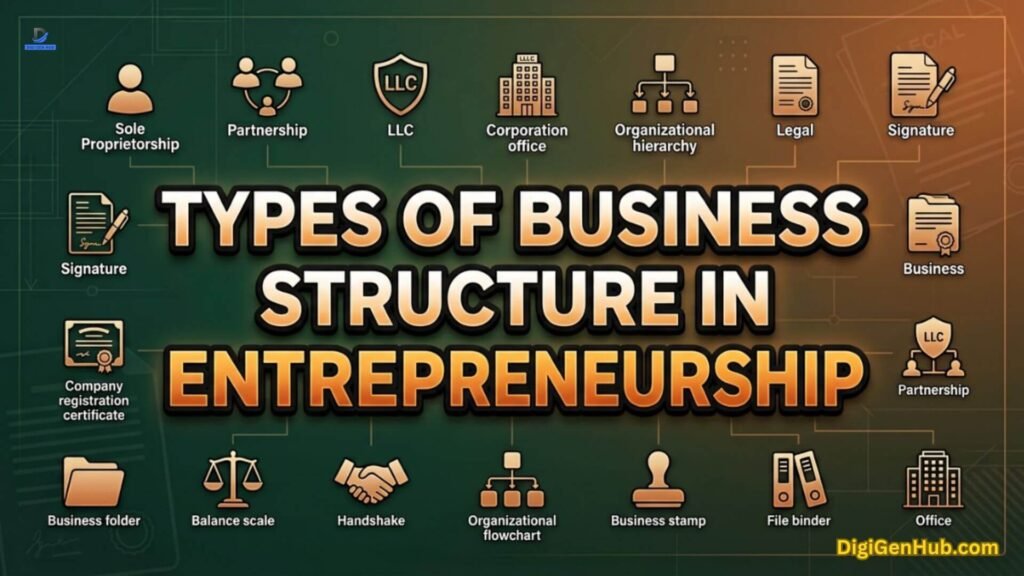
Business structure has an impact on liability, taxation and management flexibility. Yet, many entrepreneurs focus on products and marketing but ignore legal structures. This is a big mistake. To avoid this, you must know the core types of business structure in entrepreneurship.
If you want complete control but accept risk, go for a Sole Proprietorship. If you have co-founders, an LLC or Partnership provides flexibility.
If you wish for investment and protection, a Corporation is best. For social impact businesses, consider L3C or PBC. If you prefer a proven model, Franchising is a stable choice.
Still, over 70% of startups fail due to poor planning. 85% of businesses now prefer flexible models to maintain a strong position.
Indeed, correct perception can help to pick the exact business structure as needed. Otherwise, The wrong one creates legal and financial risks. So, let’s explain all the objects surrounding this vital point.
Types of Business Structures in Entrepreneurship
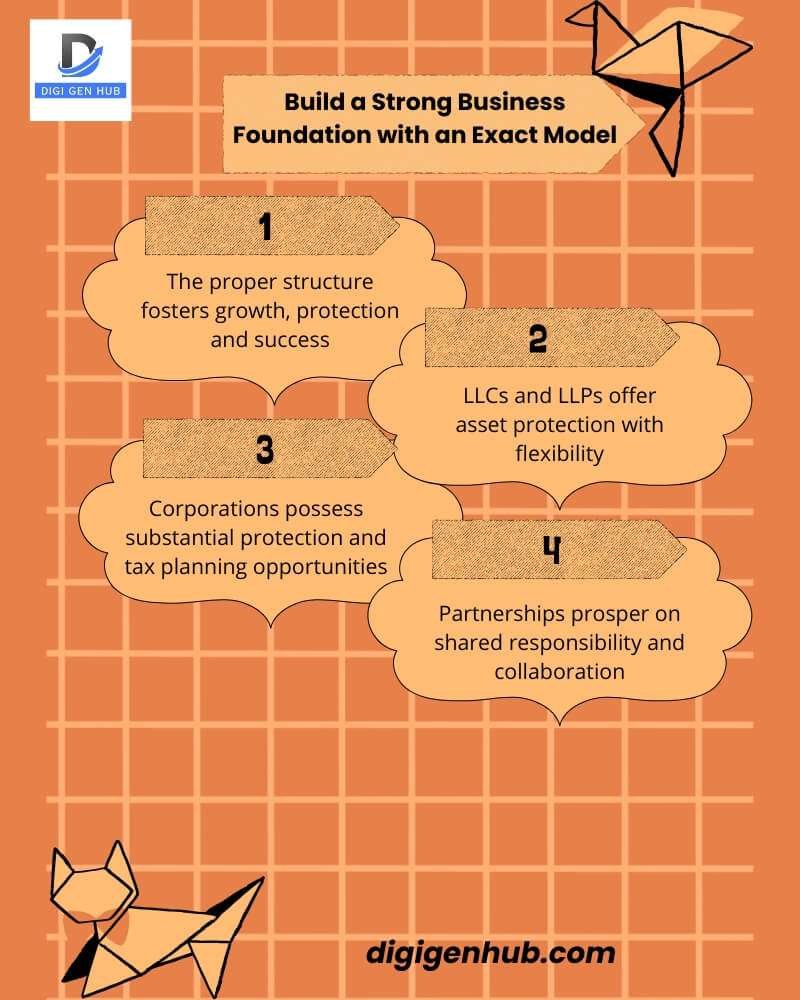
Learning business structure types helps entrepreneurs avoid legal risks, reduce taxes and attract investors. The right choice ensures long-term stability, protects assets and supports business growth.
A Sole Proprietorship gives complete control but has unlimited liability. Partnerships allow shared ownership. General Partnerships (GP) have equal responsibility. Limited Partnerships (LP) have both active and silent partners.
Limited Liability Partnerships (LLP) protect each partner from others’ mistakes. An LLC offers flexibility and shields personal assets.
Corporations (C-Corp, S-Corp) provide strong liability protection. C-Corps face double taxation, while S-Corps pass income to shareholders.
Cooperatives are member-owned and share profits. L3Cs focus on social benefits with some profit-making. Public Benefit Corporations (PBCs) balance profit and social impact.
Franchises offer a proven model under a known brand. Joint Ventures are temporary business collaborations. Holding Companies own assets but do not operate businesses.
Nonprofits (NPOs) serve social causes and do not distribute profits. Trusts and Foundations manage assets for charity or estate planning.
Chief Business Structures Types
Starting a business? You must pick the proper structure. Having an idea of different structures helps you choose the best one.
Some businesses work best alone, while others need partners or investors. Some give complete control, while others protect personal assets. The right choice makes business smoother and safer. So, let’s learn the six main types first:
What is a Sole Proprietorship
A sole proprietorship is a business owned and run by one person. It is the easiest and most common way to start a business. The owner has complete control but is also responsible for all debts. This model is booming because of online companies, freelancing and personal brands.
Why It’s a Great Choice
1 . Low Cost to Start – You don’t need much money. Many online businesses start with $500 or less.
2 . Easy to Run – No complex paperwork. You decide everything.
3 . More Profits – No partners or investors. You keep 100% of the money you make.
Simple Taxes – Business income is counted as personal income. This makes tax filing easier. Learn more from the U.S. Chamber of Commerce.
Real-Life Success
Madhu Chocolate started as a small business run by one person. The brand grew fast through social media, online ads and email marketing. Now, it sells nationwide.
Market Growth
The e-commerce market is set to reach $7.4 trillion. (Statista)
Freelancing and online work have grown 30% since 2020. (Forbes)
Skills You Need
A . Digital Marketing – Know how to promote your business online. (Digital Marketing Institute)
B . Money Management – Learn how to budget and track profits.
C . Tech Skills – Use AI tools and automation to save time.
How to Succeed
Use AI and automation – Chatbots and email tools help run things smoothly.
Personalized Service – 78% of buyers prefer brands that feel personal.
Stay Active Online – Engage with customers on social media and respond quickly.
A sole proprietorship is one of the best ways to start a profitable business. Of course, success will follow if you stay updated with digital trends and customer needs.
General Partnership (GP)
A general partnership (GP) is a business owned by two or more people who share profits, losses and responsibilities. It’s easy to start but comes with unlimited liability. Yet, it’s popular for startups, consulting and influencer collaborations.
Core Features
1 . Low Cost – Most partnerships start with $1,000–$5,000. (SBA)
2 . Shared Workload – Partners split tasks, making management more effortless.
3 . More Expertise – Diverse skills improve decision-making.
4 . Simple Taxes – Income is taxed as personal earnings. (IRS)
Real-Life Success
Warby Parker started as a general partnership and grew into a billion-dollar eyewear brand using social media, virtual try-ons and digital marketing. (HBR)
Recent Market Growth
Small businesses are growing 6.2% annually. (Statista)
Startup partnerships have increased 40% in the last decade. (Forbes)
Influencer-led partnerships drive $21B+ in sales. (Business Insider)
Necessary Skills
A . Negotiation – Set clear profit-sharing terms.
B . Financial Management – Budget, track profits and handle debts.
C . Marketing – Build a brand presence and client trust.
How to Succeed
Create a Legal Agreement – Define roles and exit strategies.
Choose the Right Partner – Shared goals and financial discipline are key.
Use Digital Tools – AI financial apps streamline budgeting.
Still, a general partnership is a low-cost, high-potential model. With clear agreements, financial planning and digital strategies, success is within reach.
Limited Partnership (LP)
A Limited Partnership (LP) is a business structure that includes:
General Partners (GPs): They manage the business with unlimited liability.
Limited Partners (LPs): They invest capital but do not participate in daily operations; their liability is limited to their investment.
This structure is standard in real estate, private equity and investment funds.
Main Functions
1 . Attracts Investors: Limited liability encourages investment without personal risk beyond the initial contribution.
2 . Pass-Through Taxation: Profits and losses pass directly to partners, avoiding corporate taxes.
3 . Flexible Capital Raising: Combining general and limited partners allows for diverse funding sources.
Real-Life Success
Bloomberg L.P., founded by Michael Bloomberg, operates as a limited partnership. This structure enabled significant capital infusion while maintaining centralized management. This contributed to its growth as a global financial information leader.
Recent Market Growth
Private Equity: LPs are standard in private equity, a sector projected to grow by 15% annually.
Real Estate: Limited partnerships facilitate large-scale property investments, with the global real estate market expected to reach $4.2 trillion.
Skills You Need
A . Investment Analysis: Assessing profitable ventures is crucial. it.wikipedia.org
B . Legal Acumen: Understanding partnership agreements and compliance is essential.
C . Financial Management: Effective budgeting and financial oversight ensure sustainability.
How to Succeed
Draft Clear Agreements: Define roles, profit-sharing and exit strategies to prevent disputes.
Maintain Compliance: Adhere to regulatory requirements to protect limited liability status.
Foster Transparency: Regular communication builds trust among partners and investors.
Limited Liability Partnership (LLP)
This business structure combines a partnership’s flexibility with a corporation’s liability protection. In an LLP, partners are not personally liable for the misconduct or negligence of other partners. en.wikipedia.org
Main Features:
1 . Limited Liability: Partners are protected from personal liability beyond their investment in the LLP.
2 . Flexible Management: Partners can directly manage the business without a formal board structure.
3 . Pass-Through Taxation: Profits and losses pass directly to partners, avoiding corporate taxation.
Advantages
Attracts Professionals: LLPs are popular among law, accounting and consulting agencies due to liability protection and management flexibility.
Global Expansion: The LLP structure facilitates international partnerships, enhancing global reach. zh.wikipedia.org+5en.wikipedia.org+5en.wikipedia.org+5
Real-Life Example:
PricewaterhouseCoopers (PwC) operates as an LLP, allowing shared management among partners while protecting individual assets. This structure has contributed to PwC’s growth into a global professional services network.
Recent Market Value
The UK’s services exports, driven by finance, law and business advisory firms, are expected to exceed £500 billion in 2025, doubling from a decade ago. thetimes.co.uk
Essential Skills for Success in an LLP:
A . Collaboration: Effective teamwork and communication among partners.
B . Financial Acumen: Understanding financial statements and tax implications.
C . Strategic Planning: Ability to set long-term goals and adapt to market changes.
Vital Aspects for Starting an LLP:
Legal Compliance: Ensure adherence to state regulations and proper filing of necessary documents.
Clear Agreements: Draft detailed partnership agreements outlining roles, responsibilities and profit-sharing.
Risk Management: Implement policies to mitigate potential business risks.
So, forming an LLP presents a balanced approach to liability protection and managerial flexibility. This quality makes it a compelling choice for professionals and entrepreneurs alike.
Limited Liability Company (LLC)
This business structure unites liability protection like a corporation and tax flexibility like a partnership. LLCs are highly preferred due to digital business growth and online entrepreneurship.
Primary Functions
1 . Limited Liability Protection – Members are not personally responsible for business debts or keeping personal assets safe (IRS).
2 . Tax Flexibility – LLCs can be taxed as a sole proprietorship, partnership, or corporation (Taxfyle).
3 . Easier Management – Fewer regulations than corporations, allowing faster decision-making (U.S. Chamber of Commerce).
Recent Market Trends
5.5 million+ new businesses were filed in the U.S. in 2023, most as LLCs (U.S. Chamber of Commerce).
E-commerce is projected to hit $7.4 trillion today. This makes LLCs the preferred structure for online businesses (Statista).
Essential Skills for Running an LLC
A . Digital Marketing – Online sales and branding must scale (Digital Marketing Institute).
B . Financial Management – Managing business expenses, taxes and profit reinvestment is essential.
C . Tech Adaptability – AI tools and automation help businesses grow faster.
Main Objects to Consider
State Regulations – LLC rules differ by state, so research local requirements (IRS).
Operating Agreement – A well-structured agreement clarifies profit-sharing and management roles.
Tax Classification – Choosing the correct tax status can maximize savings.
A Limited Liability Company (LLC) is a bright, flexible and safe business model. So, entrepreneurs who embrace online marketing, financial planning and technology will see long-term success.
Corporation (C-Corp, S-Corp)
A Corporation is a business entity separate from its owners. This provides limited liability protection. In the U.S., corporations mainly fall into two categories: C-Corporations (C-Corps) and S-Corporations (S-Corps). Let me explain:
C-Corps vs S-Corps
| Feature | C-Corp | S-Corp |
| Taxation | Pays corporate tax; shareholders pay tax on dividends | Profits pass directly to shareholders; no corporate tax. |
| Ownership | No limit on shareholders; it allows foreign investors | Max 100 shareholders; only U.S. citizens or residents |
| Stock Classes | Can issue multiple stock classes | Restricted to one class of stock |
Why Corporations Are a Great Choice
C-Corps for Tech & E-Commerce – Ideal for scaling businesses, attracting venture capital and going public.
S-Corps for Small Businesses – Better for local businesses looking to avoid double taxation (Shopify).
Real-Life Success
Apple Inc., a C-Corp, raised billions through stock offerings, fueling its $3 trillion market valuation.
Publix Super Markets, structured as a corporation, is valued at $62 billion, surpassing competitors like Target in certain regions.
Recent Market Trends
Global corporate revenue is projected to exceed $125 trillion.
E-commerce C-Corps are expected to grow by 15% annually.
Essential Skills for Running a corporation
A . Financial Management – Handling corporate taxation, stock issuance and investor relations.
B . Leadership & Strategy – Managing teams, partnerships and long-term business scaling.
C . Regulatory Compliance – Filing corporate reports and tax returns and ensuring legal compliance.
Strategic Criteria
Tax Implications – C-Corps face double taxation, while S-Corps avoid it.
Growth Potential – C-Corps are better for high-growth, investor-backed businesses.
Compliance Requirements – Both require annual reports, meetings and IRS filings.
Specialized and Modern Business Structures
The world is changing fast. People want ethical, sustainable and competent business models. Investors are putting billions into green and social impact businesses.
Digital tools and AI are reshaping industries. Hence, besides the central business structure models, they search for additional models too. So, let’s explain additional structure types:
Additional Business Structure Types
| Business Typ | Market Value & Trends | Required Skills |
| Cooperative (Co-op) | $2.9T global market | Leadership, finance, teamwork |
| L3C (Low-Profit LLC) | $715B in ESG funding | Social entrepreneurship, nonprofit management |
| Public Benefit Corp (PBC) | 90% of Gen Z prefers sustainable brands | CSR, corporate governance |
| Franchise | $4.5T industry recently | Operations, branding, compliance |
| Joint Venture | 60% of tech startups expand via JVs | Operations, branding, compliance |
| Holding Company | Controls 40% of global GDP | Investment strategy, finance |
| Nonprofit (NPO) | Contributes $1.5T to GDP | Fundraising, grant writing |
| Trusts & Foundations | Holds $1.2T+ in assets | Wealth management, estate planning |
Conclusion
Thus, choosing the proper business structure shapes your future, protects your dreams and opens doors to success. Your business is not just a company. It’s your vision, your passion and your hard work.
Whether you start alone, with partners, or under a big brand, each structure has magic. Just pick the suitable one with a visual judgement as your business demands.
FAQ
What are the three 3 types of organization structure?
Businesses have used three main structures recently. Functional (40%), where people work in groups like marketing or finance. Matrix (30%) combines project and role-based work for more flexibility. Flat (30%) has few managers, making decisions quicker. Each structure helps businesses work better in different ways.

Aliza Khatun is a Digital Marketing Professional and the founder of DigiGenHub. She has helped various businesses grow their online presence through real-world experience in marketing, branding, traffic growth, and business strategy.
Through DigiGenHub, she shows how to build and grow a business from the ground up using Website Setup, SEO, Branding, Paid Promotion, and smart digital tools.
She also highlights how AI can be used to its full potential to make content creation, automation, marketing, and business growth faster and smarter.
She believes that the right knowledge, modern technology, and the right tools can help any individual or business build a stronger online presence.