
Business management involves planning, organizing, leading and controlling resources to achieve goals efficiently. You must combine strategy, operations, HR, data and tech to achieve business growth.
Janie, my childhood friend, shared a bitter experience. She was puzzled to work with a client who owned a small online marketing agency. They faced low client retention, scattered team workflows and unclear sales tracking.
So, I suggested a few tips. I told her to organize their team roles, implement digital project tracking, analyze client data and build an operations workflow.
I also guided her to plan campaigns based on market trends and customer needs.
Three months later, Janie informed me of the result. They improved communication, training staff and monitoring results with simple dashboards.
As a result, the business increased revenue and delivered projects more efficiently.
What is business management?
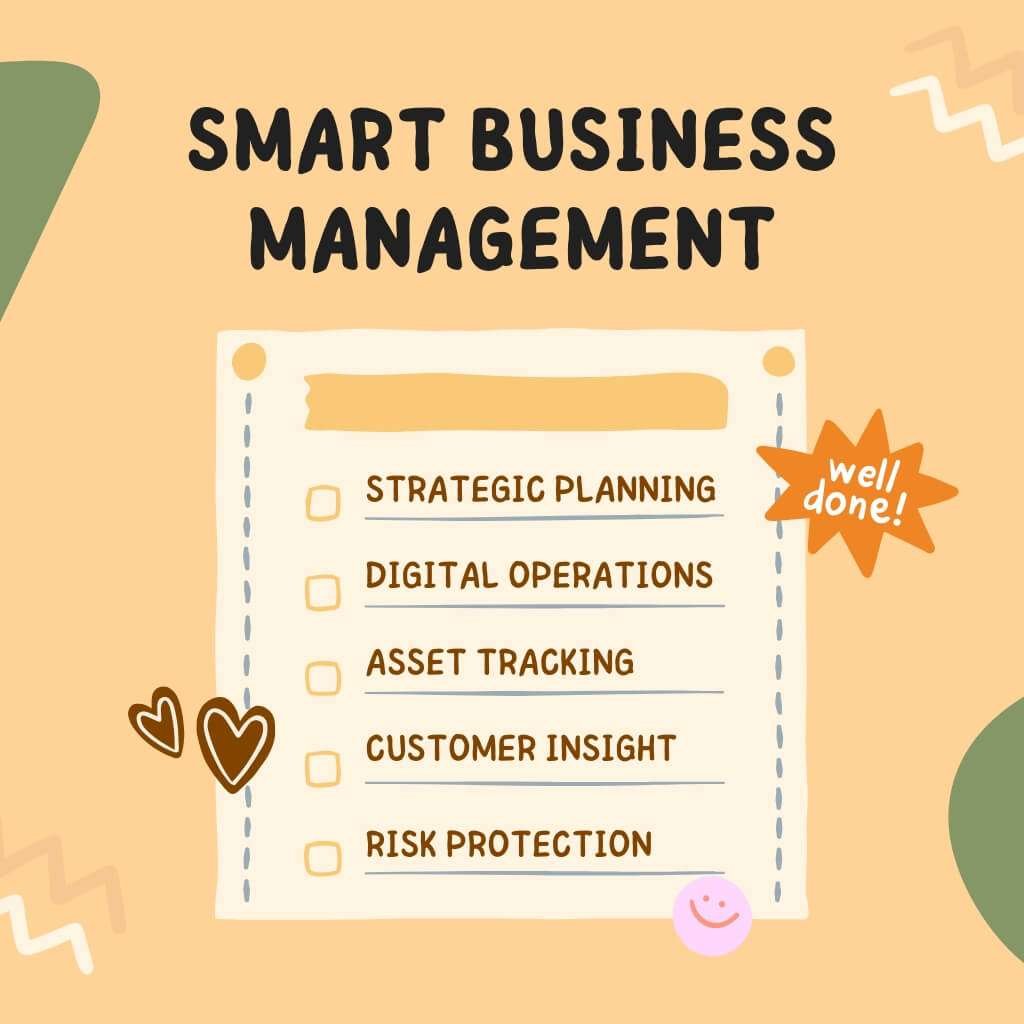
Business management guides people, money and processes. So, a firm meets what it aspires to. It rests on four tasks: plan, organise, lead and check.
Today, managers also use data tools, digital workflows, hybrid teams and ESG goals.
Again, managers utilize asset management software to track and organize all their assets in one centralized location.
It efficiently manages equipment, files and digital tools. Cloud access ensures that everything remains secure and accessible at all times. With AI and automation, it saves time and prevents costly mistakes.
Most customers today shop through their phones or laptops. Managers need to understand how these buyers search, compare and make choices online.
Adapting to their digital habits enables businesses to grow and stay ahead of the curve.
They must secure and maintain the company’s intellectual property. Protecting ideas, designs and innovations keeps competitors from copying them. Strong IP ownership also builds long-term business value and trust.
They must develop strong systems to detect and prevent fraud. Protecting business assets and data builds trust with customers and partners. A solid anti-fraud strategy also keeps operations safe and reputation intact.
What are The Core Functions of Business Management
In my 7 years of exposure to Internet marketing management, I’ve faced many challenges that digital entrepreneurs face today.
Reports show firms that ignore business structure can waste 30-50% of their resources. I experienced this early on. Once I clarified my business structure, I saw a 25-30% stability and saved on costs.
Customer data management was another issue. Studies show that using data can increase retention by 20-25%. Once I started tracking customer insights, I improved engagement by 28% and saw sales increase by 15-20%.
Inventory problems cost me too. Without the right tools, I lost 15% in sales each year due to stock issues.
After implementing inventory software, I reduced stockouts by 30% and excess inventory by 20%, resulting in improved profits.
Finally, poor cost management can cause a 10-15% profit loss. I resolved this issue by tracking expenses carefully and saving approximately 18-22% annually on unnecessary spending.
These changes helped my venture increase efficiency and profits by 25-30%. Hence, digital entrepreneurs who apply these strategies can avoid mistakes.
Whatever, business management stands on four central pillars. Planning, Organizing, Leading and Controlling are the four main functions.
Each one connects to the next like gears in motion. Together, they shape a company’s daily rhythm and long-term direction.
These functions now blend data, automation and human insight to keep operations fast and adaptive.
Managers no longer rely on yearly reviews. They act within weeks or even days using digital dashboards and scenario tools.
Managers should organize website content into clear topical clusters to make navigation easier and reduce confusion. This helps customers find what they need quickly and builds trust in the brand.
1. Planning – Set the Direction with Purpose
Planning sets the base for all business actions. It defines where the company wants to go and what path to take. In 2025, planning has moved from static documents to dynamic, data-driven systems.
Short-term and long-term balance: Companies plan quarterly but stay open to daily changes.
Scenario planning: Managers now utilize tools like Workday Adaptive Planning and Anaplan to test multiple outcomes before selecting the most effective one.
Customer-centered goals: Plans focus more on audience behavior. For instance, U.S. firms now track Google Trends and AI-based market insights to predict customer demand early.
Still, the Google Product Feed app helps you manage and promote your products more efficiently.
It keeps your listings accurate across Google platforms. This boosts visibility, attracts more buyers and improves overall business performance.
2. Organizing – Turn Plans into Structure
Organizing connects goals to people and systems. It defines roles, allocates tasks and builds clear workflows.
Modern management uses hybrid business structures that combine automation tools and human supervision.
Role clarity: Job roles are now project-based rather than department-based.
Workflow digitization: Teams use connected tools like Notion, ClickUp, or monday.com to manage cross-functional work.
Resource flexibility: Outsourcing and gig contracts quickly fill skill gaps.
Expert Insight:
“The best organizations now design their structure like a living organism — able to expand, adapt and adjust fast,” said Rita McGrath, Columbia Business School professor, in an interview with Harvard Business Review.
3. Leading – Turn Vision into Action
Leadership gives movement to plans. It means guiding teams with clear direction, empathy and timely decisions.
Modern leadership combines emotional intelligence with data clarity. Managers now act more like coaches than supervisors.
Communication first: Daily standups and open dashboards keep teams aligned.
Recognition: Digital recognition systems, such as Bonusly, enhance motivation and transparency.
Decision agility: Managers use instant feedback from analytics platforms to act quickly.
Still, a strong business owner understands the connection between law and global trade.
Understanding international regulations helps mitigate risks and avoid legal issues. This skill ensures smooth operations and smarter global expansion.
4. Controlling – Keep Progress on Track
Controlling ensures that work stays aligned with goals. It involves comparing results with expectations and fixing issues fast.
KPI dashboards: Tools like Power BI, Tableau and Google Looker Studio help managers visualize trends.
Continuous review: Weekly reviews replace yearly evaluations.
Predictive correction: AI models predict possible project delays or cost overruns early.
3. Why does Every Company Need Business Management?
Business management turns ideas into measurable results. It removes waste, aligns teams and keeps performance visible. It helps firms adapt when markets shift. Let’s explain its importance:
1. Turn ideas into results (execution matters)
Effective management closes the gap between the plan and the outcome.
Leaders translate strategy into projects, budgets and owners.
They set clear metrics and short reviews. When managers do this, teams act with a sense of purpose. Without it, plans stay ideas on slides and never deliver.
2. Cut waste and free up resources (profit effect)
Management identifies low-value work and removes it. That frees cash and time for growth tasks.
Well-run firms reduce replacement costs by lowering turnover. Harvard research shows that higher pay and better treatment at retailers like Costco cut turnover and improved margins.
3. Keep teams united (one plan, many hands)
Management turns strategy into shared priorities. It provides teams with a concise set of agreed-upon goals.
Managers assign owners and timelines. This prevents duplicated work and mixed signals. Aligned teams finish projects faster and with fewer errors.
4. Help firms adapt when markets shift (resilience)
Markets change fast. Good managers run scenario checks. They test options and pivot quickly.
They set rolling forecasts and short planning cycles. This reduces the cost of sudden shocks. Managers who plan in cycles tend to avoid lengthy recovery phases.
5. Protect culture and cut turnover (people cost)
Many employees leave their jobs due to poor leadership. Managers who coach and communicate keep talent.
Gallup and major U.S. reporting indicate that manager engagement fell sharply in 2024, negatively impacting teams and morale.
Investing in manager training raises retention and performance. Studies show training reduces turnover intentions and improves commitment.
6. Improve decision quality and risk control (governance)
Management establishes clear decision-making rights and review processes.
That reduces costly mistakes and compliance failures. Effective control systems identify issues promptly and trigger corrective measures. They also reassure investors and stakeholders with visible governance.
7. Drive customer outcomes (direct business value)
When management links operations to customer results, service improves.
Processes, training and ownership reduce errors that annoy customers.
A better customer experience leads to increased repeat business and higher lifetime value.
Additionally, managers must know how to effectively handle negative reviews. Responding with care and professionalism can turn criticism into trust. A thoughtful reply can often strengthen the brand’s reputation and foster customer loyalty.
8. Attract capital and partners (credibility)
Investors prefer firms with clear reporting, targets and accountable leaders.
Effective management demonstrates that you can spend wisely and meet forecasts. That reduces financial costs and opens up partnership opportunities.
Practical checklist — what managers should do now
1 . Develop a one-page strategy that outlines three goals for the next 12 months.
2 . Assign owners and set simple metrics for each goal.
3 . Start weekly or biweekly progress reviews.
4 . Map your top 5 processes and remove one low-value step.
5 . Conduct a brief manager training session on feedback and coaching.
6 . Publish a small dashboard for people to see progress.
These six moves bring fast clarity and reduce major failure risks.
How to Improve Business Management Skills Fast
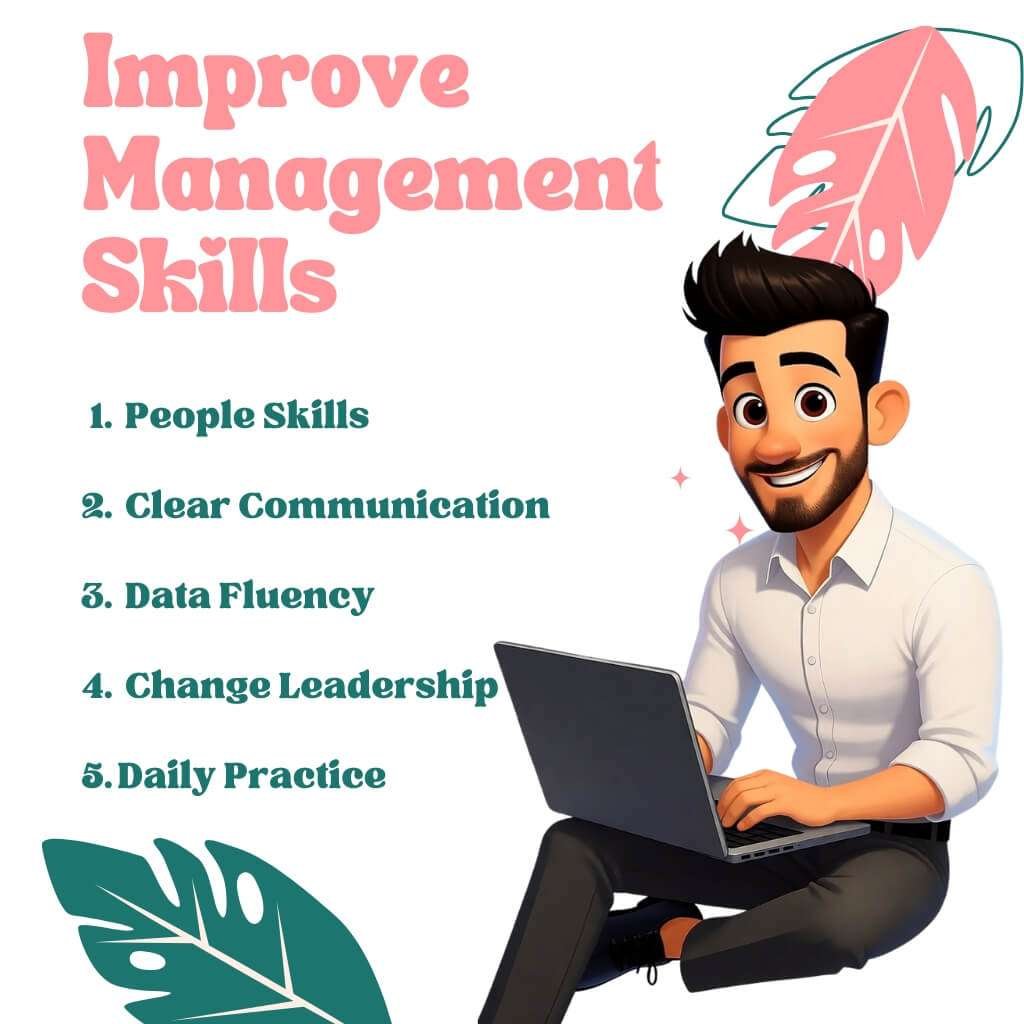
Pick one skill per quarter and practice it every day. Start with people skills and clear communication. Next, learn data fluency and dashboards. Then lead a small change project to apply what you learn.
Why this works
1 . Focusing on one skill at a time gives fast gains.
2 . Microlearning enhances retention and completion rates compared to long courses.
3 . Data fluency is now a core manager skill — leaders rank it critical for daily work.
4 . Many managers lack formal training; short, focused practice closes that gap.
Step-by-step 4-quarter plan
Quarter 1 — People skills & communication (foundations)
Assess: Run a 360° pulse or simple feedback form. (5 questions)
Daily habit: 10–15 minutes of active listening practice.
Micro-course: Take a short course on coaching/feedback (LinkedIn Learning or Coursera).
Apply: Hold weekly one-on-ones with a clear agenda and outcomes.
Measure: Track engagement (simple score) and number of resolved issues.
Why start here: Managers drive team engagement. Better managers keep people and reduce churn. Gallup finds that manager training is linked to higher employee engagement.
Quarter 2 — Decision clarity & prioritization
Learn frameworks: Study simple prioritization tools (RICE, Eisenhower).
Practice: Run a prioritization workshop for your team. Use 2–4 business goals.
Habit: Weekly 30-minute planning block with no interruptions.
Measure: Count decisions made vs. items deferred.
Why: Strong priorities reduce wasted work and focus the team’s energy.
Quarter 3 — Data fluency & dashboards
Start small: Learn one dashboard tool (Power BI, Looker Studio, or Tableau Public).
Microlearning: Spend 15–30 minutes daily on hands-on tutorials.
Build: Create a one-page dashboard with 3 metrics that matter to your goal.
Use: Review the dashboard in your weekly meeting. Ask one question about the data.
Measure: Track decisions driven by the dashboard.
Why: Managers who read data reduce guesswork and make faster, better calls. DataCamp and Qlik report leaders view data literacy as essential.
Quarter 4 — Lead a small change project (apply & prove)
Pick one project: Must finish in 8–12 weeks. Keep scope small.
Form a tiny team: 3–6 people. Give a clear owner and outcome.
Run weekly sprints: Set short goals and quick reviews. Use Atlassian “Plays” for rituals if needed.
Measure: Baseline metrics before start. Compare after the project.
Document: Capture lessons and a short case note (1 page).
Why: Real projects force you to combine people, priority and data skills. They prove you can deliver.
Daily & weekly micro habits (do this all year)
10–15 minutes of reading or a course micro-module daily.
15 minutes data practice twice a week (run one report).
One focused 90-minute deep work block weekly.
Weekly reflection: what went well, what to change.
Tools & resources (start here)
People skills: LinkedIn Learning courses, Atlassian Team Playbook plays.
Dashboards: Google Looker Studio, Power BI, Tableau Public.
Microlearning platforms: LinkedIn Learning, DataCamp and internal LMS.
Project tools: Asana, ClickUp, Jira (for agile sprints).
How to measure progress (simple metrics)
Team engagement score (monthly pulse).
Number of decisions made in weekly planning.
Dashboard-driven decisions per month.
Project outcome vs. baseline metric.
90-day skill self-rating improvement.
Common roadblocks + fixes
No time: Use 10–15 minute microlearning.
No buy-in: Start with a visible, quick-win project.
Tech overwhelm: Learn one tool at a time, not all at once.
Fear of failure: Limit scope and treat experiments as learning.
AI and Automation in Business Management
AI accelerates analysis, automates routine tasks and generates options for informed decisions.
Many firms adopt AI, but outcomes vary widely. Run small pilots, keep humans making final calls and guard against bias.
1) Why AI becomes the core
Adoption jumped: most firms reported AI use in 2024. AI shortens analysis time and surfaces patterns humans miss. Automation frees staff from repetitive tasks. This allows them to focus on higher-value work.
2) Where AI helps business managers most (practical uses)
Data analysis & forecasting. Predict demand and cash flows.
Customer care drafting & routing. Draft replies and route tickets to the right team.
Automation of routine tasks. Auto-fill forms, reconcile records and schedule reports.
Idea generation & briefs. Draft campaign concepts or product outlines for review and feedback. AI tools like ChatGPT make creating digital products easier and faster. They help with ideas, writing and design. AI saves time and improves creativity. New tools make your products more appealing and effective.
Risk signals. Flag anomalies in spending, fraud, or supplier behavior.
3) What successful pilots look like
Pick one clear problem. Choose a narrow, measurable process.
Set one metric. Time saved, error drop, or lead conversion lift.
Use off-the-shelf models first. Avoid costly custom builds from the start.
Run a 6–12 week pilot. Keep scope small and measurable.
Measure human oversight needs. Track where humans intervene and why.
Decide: scale, revise, or stop. Use data, not hype. Gartner warns that many agentic AI projects will fail if not practical.
4) Governance & risk controls (must-do list)
Bias checks. Test models on diverse data slices.
Explainability. Record why the AI gave a suggestion.
Access control. Limit who can change models or training data.
Audit trail. Keep logs of inputs, outputs and human overrides.
Clear handoffs. Humans own final decisions for customer, legal, or financial outcomes.
Policy: Publish a short internal AI use policy and training. McKinsey finds that leadership and governance often significantly determine the success of AI.
5) Metrics to track AI pilots
Time saved per task (hours).
Error or exception rate (%) before vs after.
% of tasks automated end-to-end.
Human override rate (%) and reason codes.
Business outcome link (e.g., conversion lift, cost per case).
Track these weekly in the pilot and monthly after rollout.
6) Tools and vendors to try (practical picks)
RPA & automation: UiPath, Automation Anywhere, Power Automate.
Generative models & copilots: Anthropic Claude, OpenAI, vendor-built copilots (embedded in enterprise suites).
BI + ML platforms: Power BI, Looker, DataRobot for predictive models.
Start with low-cost pilots on one tool before expanding.
7) Common failure modes (and fixes)
No clear use case. Fix: pick one measurable task.
Poor data quality. Fix: clean and label a small training set.
Over-automation too soon. Fix: keep humans in the loop.
Unclear ROI. Fix: tie pilot metrics to an actual business outcome.
Vendor mismatch. Fix: Run a proof of concept before signing the contract.
Gartner expects many early attempts at agentic AI to be scrapped due to a lack of clear business value.
8) Change management: how to bring teams along
Train staff on new tools before launch.
Show quick wins in the first 4–8 weeks.
Collect frontline feedback and iterate.
Reward staff for accurate human verification.
Publish a short “how we use AI” note for customers and partners.
Gallup and Business Insider show leaders adopt AI faster than the rank-and-file. Training reduces resistance.
What’s the Challenge in Business Management and the Quick Fix?
Modern managers face tighter budgets, faster change and scattered teams. Each challenge cuts efficiency and profit.
1. Remote Work Friction
Remote work still divides teams and blurs communication. People lose context, meetings pile up and projects slow down.
Fix it fast:
Create short, purpose-driven meetings. Share notes before, not after.
Use shared documents and task trackers as the single source of truth.
Record short updates for async clarity instead of endless live calls.
Add “no meeting hours” to restore focus and prevent burnout.
Tool tip: Notion, Confluence and Loom improve async visibility.
Metric to watch: Weekly meeting hours per person and task completion rate.
2. Fast Tech Change
New tools appear every quarter. Teams often adopt them without structure and waste budget.
Fix it fast:
Reserve two hours weekly for tech learning.
Test tools through 6–8 week pilots with one success metric.
Assign clear ownership for every platform.
Maintain a simple tech register that lists cost, usage and owner.
Metric to watch: Pilot ROI and adoption time per new platform.
Tool tip: LinkedIn Learning, Coursera and vendor sandboxes.
3. Talent Gaps
Hiring takes longer and internal skills often fail to keep pace with demand. This gap limits growth.
Fix it fast:
Map existing skills before hiring outside.
Offer short credentials tied to promotions.
Develop internal training tracks that are closely tied to real-world projects.
Utilize fractional experts to fill gaps in niche skills.
Metric to watch: Internal fill rate and skills coverage ratio.
Tool tip: LinkedIn Talent Insights and internal learning dashboards.
4. Cost Pressure
Margins remain tight as inflation and supply costs persist at high levels. Managers must protect profit without freezing innovation.
Fix it fast:
Review the top five expense categories on a quarterly basis.
Cut or merge subscriptions with low engagement.
Tie every project’s funding to measurable business impact.
Run one experiment per quarter to reduce recurring spend.
Metric to watch: Cost per customer and general admin expense ratio.
Tip: Utilize spend analysis platforms and lightweight ERP dashboards.
5. Cross-Team Misalignment
Departments often chase separate goals. Work overlaps. Customers feel the gap.
Fix it fast:
Publish three company-level KPIs and align all teams under them.
Schedule one weekly sync focused only on decisions.
Bring customer feedback into planning sessions.
Assign one project lead per cross-department initiative.
Metric to watch: Cross-team project cycle time and milestone accuracy.
Tool tip: OKR tools like Perdoo or Weekdone and unified dashboards.
What’s Coming and How to Lead Through It
Expect tighter data rules and stronger cyber defenses. Managers must mix people skills with tech fluency. Sustainability will influence routine decisions. Low-code and automation will accelerate the pace of work.
Managers must care about cybersecurity. Online threats can harm any business. Data and customer trust are at risk. Strong protection and staff training are essential.
Protecting customer information is essential. Data breaches are rising everywhere. Use advanced tools and strong security layers to prevent them. Safe systems build trust and keep customers loyal.
1) Stronger data rules and governance — what to do now
Regulators and customers demand better data control. Companies must publish who owns each dataset. Create a simple data catalog and access policy. Run annual data audits and privacy checks.
Practical steps for managers
Name a data owner for every major dataset.
Build a one-page data policy (access, retention, use).
Log data sources and consent status.
Run a quarterly data health check with IT.
What to measure
% of datasets with owners.
Time to revoke access.
Number of privacy incidents per quarter.
Yet, poor data governance stops AI and analytics from delivering value. Good governance makes data usable and defensible.
2) Tighter cyber posture — practical fixes
Threats keep growing. Credential theft and phishing surged in 2025. Firms must harden access and monitoring.
Essential actions today
Enforce MFA and SSO for all employees.
Adopt zero-trust access for critical systems.
Patch known vulnerabilities weekly.
Run tabletop exercises for breach response.
Log and keep an audit trail of privileged actions.
Tools and vendors to consider
SASE / ZTNA providers for hybrid work.
Managed detection and response (MDR) for smaller teams.
Secure password vaults and identity platforms.
Metrics that matter
% workforce on MFA.
Mean time to detect (MTTD) and mean time to remediate (MTTR).
Number of privileged access reviews.
A single stolen credential can result in significant losses. Solid controls reduce that risk and protect reputation.
3) Managers need people + tech skills — how to build them
Managers must coach teams and read data. They must also pick the right tools.
Skill mix to develop now
Communication & feedback (people skills).
Data literacy — read dashboards and ask the right questions.
Basic automation know-how — what tasks can be automated.
Risk and ethics awareness for AI and data.
Fast training plan (90 days)
Month 1: coaching and feedback practices.
Month 2: basic dashboards and KPI interpretation.
Month 3: run a small automation pilot with a vendor.
Measure progress
Manager confidence score on data tasks.
Number of decisions informed by dashboards.
Completed automation pilots that saved X hours.
Managers who mix human judgment with tech tools make better, faster choices.
4) Sustainability shapes everyday business choices
Sustainability moves from nice-to-have to an operational requirement. Buyers, investors and partners expect measurable climate action.
Concrete moves for managers
Track carbon per product or service.
Add sustainability targets to quarterly goals.
Prefer vendors with published environmental data.
Conduct small pilots to explore energy or waste reduction opportunities.
What to report internally
Emissions per unit produced.
% materials sourced responsibly.
Progress vs. sustainability goals.
Sustainability affects cost, brand and access to capital. Firms that measure it early avoid compliance surprises.
5) Low-code / no-code and process automation will speed change
Low-code platforms already power many new apps. Forrester and market trackers show fast adoption. By 2026, most new apps will use low-code tools.
How to adopt without chaos
Approve a short list of enterprise low-code tools.
Train “citizen developers” with guardrails.
Require a simple review for any app that touches critical data.
Start with automating one repetitive process per team.
Metrics to track
% new apps built on low-code.
Time to market for new business apps.
Error rate and incidents from citizen apps.
Common Myths about Business Management
Myth 1 — “Managers only give orders.”
Truth: Modern managers coach and remove roadblocks.
Why: Managers now spend time developing people, not just assigning tasks. Coaching drives productivity and retention.
Harvard Business Review and L&D studies show regular coaching lifts performance more than top-down commands.
Practical action: Train managers to run weekly one-on-ones and short coaching huddles. Measure improvement with engagement and performance scores.
Myth 2 — “Only big firms need management.”
Truth: Small firms gain more from good management.
Why: Small teams respond faster to clear roles, priorities and simple processes. Tight management reduces waste and scales revenue. Deloitte’s human capital work shows that well-run small firms close skill gaps quickly through focused management practices.
Practical action: For small firms, publish 3 quarterly goals, assign owners and hold a weekly 30-minute sync.
Myth 3 — “Tech fixes everything.”
Truth: Technology helps, but people still make the decisions.
Why: Tools speed work, but poor decisions or a weak culture block results. McKinsey finds that about 70% of transformations fail because leaders don’t change how people work. Tech without leadership and governance wastes money.
Practical action: Run short pilots and require human sign-off on AI or automation decisions. Track human override rates and errors.
Myth 4 — “Strategy alone wins.”
Truth: Strategy plus daily execution wins.
Why: Strategy sets direction. Execution closes the gap. Firms that update plans often and track short cycles perform better than those relying on static strategy documents. Gallup and transformation research show execution gaps kill value.
Practical action: Turn each strategic aim into 2–3 operational projects with owners and weekly checkpoints.
How to Build a Career in Business Management

1 . Get practical experience in cross-team projects.
2 . Learn data basics and people skills.
3 . Find a mentor in U.S. firms or networks.
4 . Lead a 90-day improvement project for proof.
U.S. job projections show steady demand for management roles.
The Backbone of Modern Business Leadership
Business runs on strong foundations. The core branches guide decisions. They shape how resources move and teams perform.
Knowing them helps leaders spot gaps. It also reveals opportunities. Experting these branches enables a business to remain agile and ready for change.
Core Branches of Business Management
| Branch | Main role | Typical tools/skills |
| Strategic management | Set long-horizon aims | Competitive analysis, vision maps |
| Financial management | Track funds & forecasts | Cash models, forecasting tools |
| HR management | Hire, engage and retain people | HRIS, engagement surveys |
| Operations management | Deliver products/services | Process mapping, KPIs |
| Marketing management | Reach customers | Analytics, ad platforms |
| Project management | Deliver initiatives | Agile boards, Gantt tools |
Strategic Management – How Leaders Drive Long-Term Growth
Strategy defines a company’s direction. It helps leaders make long-term choices. A good strategy links big goals to daily actions.
Strategy Process from Planning to Execution
| Step | Action | Output |
| Analyze | Market & internal scan | Insights & risks |
| Formulate | Pick initiatives | Strategic bets |
| Plan | Allocate resources | Ownership & budgets |
| Execute | Launch projects | Progress toward goals |
| Monitor | Review & adjust | Informed decisions |
What Is Strategic Management?
Strategic management is the art of setting long-term direction. It decides where to invest, what markets to enter and which products to prioritize. Leaders use it to guide all major business decisions.
Strategy now must consider hybrid markets and digital platforms.
Managers combine data signals with intuition to identify areas for growth.
Sustainability and ESG are now integral to strategic decision-making.
How to Create a Winning Business Strategy
1 . Set a 3–5 year vision.
2 . Understand competitors, market trends and customer needs.
3 . Identify the few initiatives that deliver the highest value.
4 . Design metrics to measure success.
5 . Assign clear ownership for each initiative.
6 . Test ideas in small-scale experiments before scaling them up.
Steps in the Strategic Management Process
Environmental Scan: Assessing Market Opportunities and Threats.
Internal Analysis: Review resources, capabilities and gaps.
Strategy Formulation: Identify key focus areas and initiatives.
Strategy Implementation: Allocate resources and launch projects.
Monitoring & Adjustment: Track results and adjust tactics.
Many companies now utilize AI dashboards to track strategic KPIs on a weekly basis, rather than quarterly.
Difference Between Strategy and Tactics
Strategy: Long-term direction, market positioning, resource allocation.
Tactics: Short-term actions, specific projects, operational moves.
Why it matters: Companies fail when tactical efforts don’t align with strategic intent.
Tip: Map all projects to the strategic priorities to maintain alignment.
SWOT and PESTLE: Tools for Strategic Planning
SWOT: Identify internal strengths/weaknesses and external opportunities/threats.
PESTLE: Scan political, economic, social, technological, legal and environmental factors.
Combining both tools helps predict disruptive shifts, such as the adoption of AI or new regulatory changes in the U.S.
Practical application: Utilize SWOT for internal team discussions and PESTLE for board-level decision-making.
How to Align Strategy with Business Goals
Translate strategy into measurable targets.
Ensure that every department has goals aligned with these targets.
Set clear responsibilities and timelines.
Run monthly check-ins to track alignment.
Utilize visual dashboards to enhance visibility and alignment across hybrid teams.
Common Mistakes in Strategy Planning
Vague objectives: Leads to wasted effort. Fix: Write measurable goals.
Ignoring external changes: Markets evolve fast. Fix: Include scenario analysis.
No ownership: Projects stall. Fix: Assign accountable leaders.
Overcomplicating: Teams get lost. Fix: Keep 2–4 main priorities.
Advice: Short, clear strategies outperform lengthy documents.
AI in Strategic Decision-Making
AI analyzes trends, forecasts demand and predicts risks.
AI helps simulate market scenarios without committing resources.
Humans remain in charge of judgment and ethical decisions.
Companies using AI for strategy report faster insights and more confident decisions.
Strategic Management Frameworks Explained
Porter’s Five Forces: Analyze industry competition and profitability.
Balanced Scorecard: Track financial, customer, internal process and learning metrics.
OKRs: Set measurable objectives and review results frequently.
Blue Ocean Strategy: Identify untapped markets with low competition.
Tip: Select the framework that best suits your company’s current needs and challenges.
Future of Strategic Management in the Digital Age
Managers will combine human judgment and AI insights.
Faster decision cycles and modular business models will become Talent with tech fluency and strategic thinking will be in demand
ESG and sustainability will be non-negotiable in strategy.
Agile strategies that can pivot quickly will outperform static multi-year plans.
Human Resource Management: Lead People with Impact
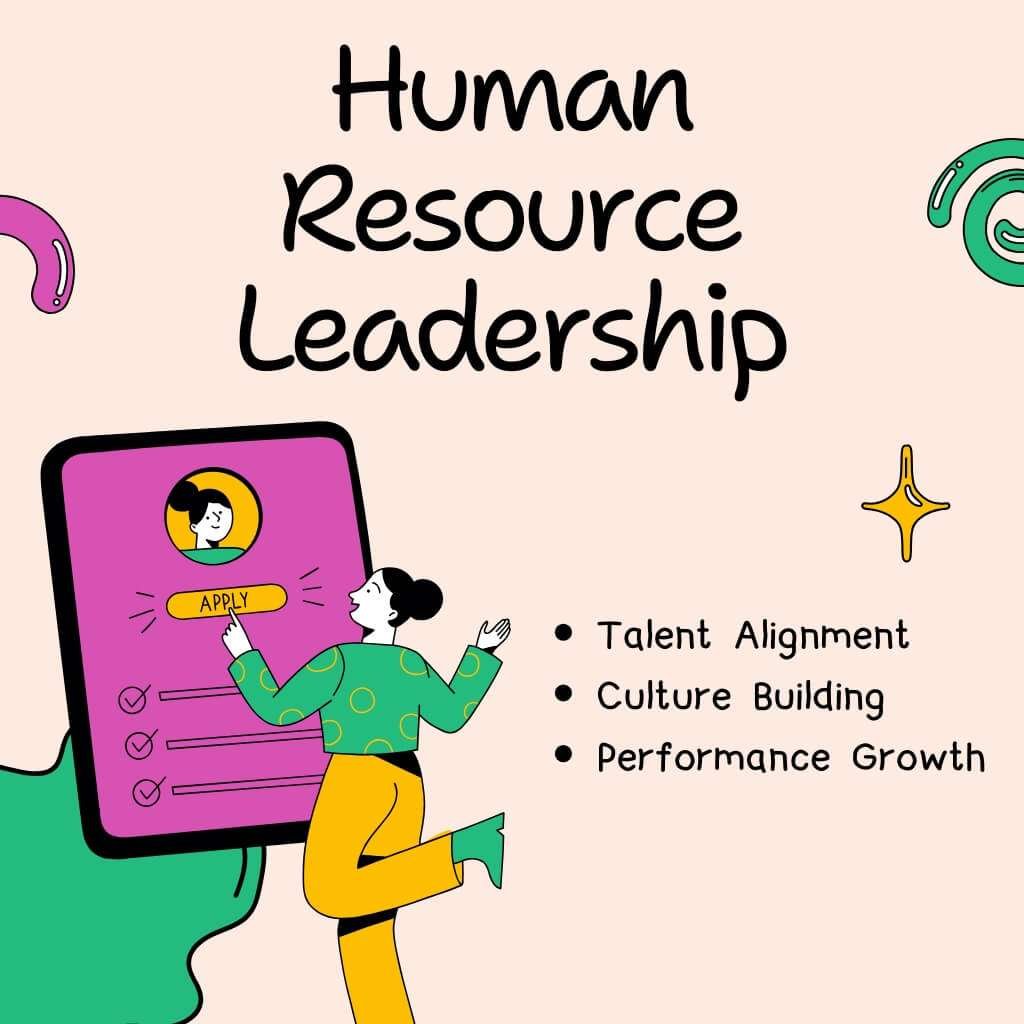
HRM guides how people are hired, trained and kept motivated. It ensures culture aligns with business goals and talent drives growth.
What Is Human Resource Management (HRM)?
Human Resource Management involves managing a firm’s people and culture to achieve optimal performance.
It handles recruiting, onboarding, training, performance management and employee retention. It aligns talent with business goals and helps shape company culture.
Core Functions of HRM: Recruitment, Training & Retention
HRM Functions and Tools
| Function | Main Activities | Tools/Skills |
| Recruitment | Attracting and selecting talent | ATS, AI screening, employer branding |
| Training & Development | Upskilling and career growth | LMS, micro‑learning, coaching |
| Retention | Engagement, culture, career paths | HRIS analytics, recognition platforms |
| Performance Management | Goals, feedback, measurement | OKRs, continuous feedback platforms |
| DEI | Diversity, equity and inclusion efforts | Bias‑free hiring tools, pay equity software |
| HR Analytics | Data and insights for decision making | HR dashboards, predictive analytics |
Recruitment: Identify needed roles, attract candidates and select the right people. Hiring remains hard: U.S. HR leaders struggle with talent gaps.
Training: Upskill employees in new skills and technology. Many firms now embed micro‑learning and continuous development.
Retention: Keep the right people by engaging them, fostering a culture and providing opportunities. DEI and remote flexibility now play large roles in retention.
Successful HRM manages all three functions as a unified system, rather than as separate tasks.
How to Build an Employee‑Centric Company Culture
A culture prioritizes people and aligns work with its values.
Steps:
1 . Define and communicate core values.
2 . Enable transparency and feedback loops.
3 . Support work‑life balance and flexibility.
4 . Recognize and reward contributions.
Involve employees in decisions and changes. Research indicates that companies with a strong culture outperform their peers in terms of employee retention and overall performance.
Why Employee Engagement Matters for Productivity
Engaged employees work more, stay longer and refer others. Low engagement causes turnover and productivity loss.
In the U.S., approximately two-thirds of workers report that they are not engaged or actively disengaged.
HR must measure engagement, act on feedback and close the loop to ensure ongoing improvement.
Remote Work Management and Global HR Trends
Remote work is no longer temporary. As of mid-2025, approximately 22% of U.S. workers still work from home.
HR must handle:
Hybrid work models with a remote and on‑site balance.
Global talent pools and compliance across states/countries.
Virtual onboarding and remote team culture.
Measurement of remote productivity and well-being.
Remote work expands talent access—but increases complexity.
HR Tech: How AI Is Transforming Human Resource Management
AI and automation impact numerous HR tasks, including resume screening, scheduling and learning paths.
Stats: HR staff spend up to 57 % of their time on admin tasks.
Use cases:
Predict attrition and identify retention risks.
Automated onboarding workflows.
Analytics to identify skills gaps.
However, HR must also address bias, transparency and ethics.
Performance Management Systems Explained
Performance management means setting goals, giving feedback and measuring outcomes.
Firms shift from annual reviews to continuous feedback cycles. Use clear metrics, frequent check‑ins and development plans. Connect performance with career growth and skills.
The Role of HR in Business Growth
HR is no longer administrative. It’s a growth partner. HR drives workforce strategy, culture, skill‑building and change readiness.
When HR aligns talent strategy with business strategy, firms show higher growth rates and lower costs. Therefore, HR must join strategy sessions, not just execute hiring.
Conflict Management: How to Solve Workplace Disputes
Conflicts hurt morale and productivity. HR should handle them early and fairly.
Steps:
Encourage open communication and listening.
Investigate facts and context.
Facilitate mediation or peer resolution.
Document outcomes and follow up.
Utilize data from conflicts to enhance culture and prevent recurring issues. Strong HR conflict processes create trust and effectiveness.
DEI (Diversity, Equity & Inclusion) in Modern HRM
DEI is now a business imperative. Stat: 83% of employers report having DEI initiatives in place.
Actions:
Build diverse talent pipelines.
Remove bias from hiring, performance and promotions.
Ensure equity in pay and opportunities.
Foster inclusion so every employee feels they belong. DEI moves beyond boxes to performance and growth drivers.
HR Analytics: Using Data for Better Decisions
HR analytics involves tracking key metrics. This includes turnover rate, skill gaps, hiring funnel efficiency and employee engagement.
Stat: 60 % of HR leaders say they struggle to prove the ROI of HR initiatives.
Utilize dashboards, integrate HRIS with business systems and connect HR data to financial outcomes. Use analytics to anticipate problems, not just report them.
Operations & Performance Management – Turn Strategy into Action
Operations management ensures a company’s strategy turns into results. It covers people, processes and resources. Efficiency, quality and the adoption of AI are priorities.
What Is Operations Management?
Operations management (OM) is the process of planning, organizing and supervising the production of goods and services.
It ensures that resources such as staff, machines and materials are used efficiently. OM integrates AI, automation and sustainability practices.
Efficient operations save money, improve customer satisfaction and allow businesses to scale quickly.
How to Optimize Daily Business Operations
Optimizing daily operations involves streamlining workflows to increase efficiency and minimize waste.
The Flow of Operations from Plan to Output
| Stage | Focus | Tools/Methods |
| Planning | Set goals and allocate resources | ERP, forecasting software and resource planning |
| Process Design | Map workflow, reduce waste | Value stream mapping, process modeling |
| Execution | Carry out operations | Task management software, RPA |
| Monitoring & Control | Track KPIs, detect deviations | Dashboards, analytics, inspections |
| Continuous Improvement | Reduce cost, improve speed/quality | Lean, Six Sigma, PDCA cycles |
Steps to optimize:
Map processes: Visualize each step to identify bottlenecks and areas for improvement.
Assign clear roles: Ensure everyone knows responsibilities.
Measure performance: Track KPIs such as production speed, error rates and customer satisfaction.
Implement incremental changes: Small, frequent improvements are more effective than one-time fixes. Adjust quickly based on data.
Operations vs Project Management – Distinctive Features
Operations management: Focuses on ongoing, daily processes and long-term efficiency.
Project management: Focuses on temporary, goal-oriented initiatives.
Confusing these roles can delay projects, misallocate resources and lead to increased costs. Each manager should be aware of which approach applies.
Lean Management Principles Explained
Lean management aims to eliminate waste and improve value.
Core principles:
1 . Identify value from the customer’s perspective.
2 . Map value streams to find inefficiencies.
3 . Improve flow by reducing bottlenecks.
4 . Pull production only when needed.
5 . Continuously improve processes.
Process Improvement Tools Every Manager Should Know
Popular tools:
Kaizen: Continuous, small improvements.
PDCA (Plan-Do-Check-Act): An Iterative approach for processes.
Value Stream Mapping: Visualizes workflows to reduce waste.
Business Process Modeling: Digital design of processes.
RPA (Robotic Process Automation): Automates repetitive tasks.
Effect: Saves time, reduces errors and improves output.
Measuring Business Performance (KPIs and Metrics)
KPIs track progress against goals.
Important KPIs:
1 . Cycle time (speed of delivery).
2 . Cost per unit/service.
3 . Customer satisfaction (CSAT or NPS).
4 . Employee productivity and engagement.
5 . Inventory turnover.
Yet, inventory management software keeps business operations running smoothly. It tracks stock, orders and deliveries in real time. Automation reduces mistakes and saves time. Clear insights help plan more effectively and reduce costs.
Supply Chain and Resource Management Basics
Supply chain management ensures materials move efficiently from suppliers to customers.
AI-powered logistics software transforms supply chain management. It predicts demand, optimizes routes and automates operations.
This increases efficiency, reduces costs and ensures timely deliveries.
You must focus:
Risk management: diversify suppliers.
Digital tracking: IoT sensors and analytics.
Inventory optimization: avoid excess stock.
Vendor collaboration: improve speed and quality.
Benefit: Strong supply chains reduce costs and improve service reliability.
Quality Management: How to Maintain Standards
Quality management ensures products and services meet defined standards.
Methods:
ISO certifications and audits.
Routine inspections.
Customer and employee feedback loops.
Data-driven monitoring for defects.
Sustainability in Operations: Greener Business Practices
Sustainability is now a core part of operations management.
Practical practices:
Energy-efficient production.
Waste reduction and recycling.
Responsible sourcing of materials.
Digital monitoring of carbon footprint.
AI and Automation in Operations Efficiency
AI and automation improve speed, accuracy and decision-making.
Applications:
Demand forecasting.
Workflow automation.
Predictive maintenance of equipment.
Caution: Managers must supervise AI systems to prevent errors and bias.
Conclusion
Business management turns plans into results. Strategy guides the direction, operations run the daily work and HR builds the team behind it. Data and insights help make clear decisions. Each challenge presents an opportunity to improve and grow. Every milestone shows progress toward bigger goals. With focus and action, any business can succeed.
FAQ
What new leadership roles will emerge in business management next?
Roles such as AI Ethics Manager, Hybrid Workforce Director and ESG Strategy Lead will become common as companies integrate tech, remote work and sustainability into operations.
How will data governance impact business management soon?
Organizations will invest heavily in data protocols and governance. Global big data analytics spending is predicted to reach US$420 billion in 2026.
What will the four‑day work week mean for management practice coming up?
More companies will pilot shorter work weeks. This shift in management toward outcome-based tracking, rather than hours logged, aligns with emerging research on productivity.
How will consumer expectations impact business management in the near future?
Customers will expect ultra‑personalized experiences and fast delivery. Managers will align operations and strategy more tightly to meet on‑demand models.
What risk will operations managers face due to global supply disruptions?
More frequent supply chain shocks will mean managers must build dual‑sourcing, flexibility plans and dynamic resource allocation to stay resilient.
How will the hybrid/remote team culture evolve in the upcoming years for HR and management?
Remote-first culture will shift to “distributed collaboration” with team hubs, virtual social norms and managers trained in virtual trust and accountability.
What scale of automation will operations management reach by 2026?
More than 60% of repetitive data‑management tasks are predicted to be automated by 2027. This means managers will oversee fewer manual tasks and focus on oversight.
How will business management integrate sustainability into KPI frameworks in the near future?
Environmental and social metrics (e.g., carbon footprint per unit, diversity ratio) will be tracked in conjunction with financial metrics. This creates a blended performance dashboard.
How will HR analytics evolve next year to prevent talent loss?
Predictive models will forecast attrition with higher accuracy. For example, AI tools in HR now anticipate turnover with ~87% accuracy.
What types of business models will appear in response to AI and platforms?
Platform‑as‑service models, subscription bundles and ecosystem partnerships will dominate. Managers will shift from product‑centric to ecosystem‑centric thinking.
How will DEI efforts shift in corporate management?
DEI will transition from a “program” to a “core business metric” status. Companies will tie executive compensation to outcomes related to inclusion and cultural metrics.
What metrics will define operational excellence for U.S. firms?
Metrics such as process cycle time, sustainability index and digital throughput will matter more than traditional cost per unit alone.
How will small businesses handle technology adoption?
Small firms will adopt low‑code tools, AI‑powered dashboards and scalable cloud operations to compete. Rhinos show that 86% of U.S. small business owners say they can pivot quickly.
What will strategic planning look like next?
It will shift to shorter cycles—quarterly and monthly strategy reviews rather than annual. Plans will be adjusted based on live data and scenario modeling.
How will business management education change by 2026?
Micro‑credentials, AI simulation labs and VR leadership training will gain prominence, replacing long traditional MBA programs in many cases.
What governance challenges will management face with AI next?
Managers must monitor algorithmic bias, ensure transparency and set oversight frameworks. Half of U.S. employees reportedly already use AI tools at work without telling managers.
How will cross‑functional collaboration evolve next?
Collaboration will be managed via integrated platforms where strategy teams, HR, operations and marketing share one live dashboard and joint ownership.
What will the cost structure of U.S. businesses look like?
According to a forecast by Kiplinger, business costs are expected to rise moderately (corporate profits are projected to increase by ~10%), while wage and benefit increases are anticipated to remain modest (at around 3.5–4%).
How will employee development shift to support business management?
Learning will be continuous, on‑demand and data‑driven. Companies will track learning impact and link development directly to business outcomes and roles.
How will business leaders evaluate company readiness for future disruptions?
Leaders will use “future‑readiness” indicators that score companies on innovation, resilience, workforce capability and ESG metrics.
What does a business manager do?
They set goals, assign work, lead people and measure results.
Is management the same as administration?
No. Management guides strategy and people. Administration runs routine tasks.
How many priorities should a strategy have?
Keep 2–4 main initiatives.
How often should strategy be reviewed?
Update yearly, check progress monthly.
Who owns strategy delivery?
A senior leader with authority and budget.
How can small teams test strategy?
Run pilots, gather data, then scale.
What is the hardest HR challenge today?
Talent shortage combined with rapid skill change and hybrid work.
How should HR handle budget cuts?
Focus HR spend on high‑impact areas, use analytics to show value and consolidate tech tools.
What must HR do about AI?
Develop ethical frameworks, train talent in AI use and keep humans in final decisions.
What’s the easiest improvement for small businesses?
Map processes and fix the largest bottleneck first.
Should small firms adopt AI now?
Yes, start with simple automation like scheduling or reporting.
How can quality be maintained without a big budget?
Use simple checks, customer feedback and regularly track KPIs.

Aliza Khatun is a Digital Marketing Professional and the founder of DigiGenHub. She has helped various businesses grow their online presence through real-world experience in marketing, branding, traffic growth, and business strategy.
Through DigiGenHub, she shows how to build and grow a business from the ground up using Website Setup, SEO, Branding, Paid Promotion, and smart digital tools.
She also highlights how AI can be used to its full potential to make content creation, automation, marketing, and business growth faster and smarter.
She believes that the right knowledge, modern technology, and the right tools can help any individual or business build a stronger online presence.